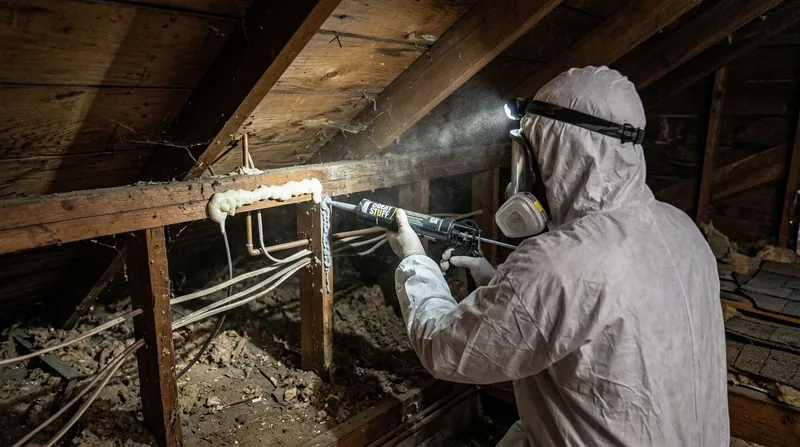




Air sealing in Dayton stops the stack effect that pulls cold winter air through gaps in older homes near the Oregon District and South Park, and seals the summer humidity pathways that drive moisture into basements and crawl spaces across the Miami Valley. Dayton's housing stock spans three eras: pre-1950 brick and stone homes with open wall cavities, mid-century ranches in Kettering and Huber Heights with uninsulated rim joists above the foundation, and newer two-story builds in Centerville and Beavercreek with conditioned rooms over garages. In winter, warm air escapes through the top plate and penetrations; in summer, humid air drives inward through the rim joist and band joist, cooling basement concrete and feeding mold risk year round. We seal penetrations, top plates, and rim joists so conditioned air stays put through both seasons. Our approach combines spray foam and mechanical air sealing to close the gaps that fiberglass and batt insulation leave behind, and we do it without the guesswork of generic estimates.
Why Air Sealing Matters in Dayton Homes
The stack effect is strongest in older Dayton homes where the Oregon District, South Park, and Oakwood hold buildings with stone basements, open wall cavities, and attics that were never sealed. Cold air enters at the foundation and rim joist, rises through the house, and exits at the top plate and roof penetrations, cycling conditioned air outside and replacing it with unconditioned outside air. In the Miami Valley's cold, snowy winters, this means your furnace runs longer and your heating bill climbs. In humid summers, the reverse happens: warm, wet air infiltrates through the same gaps, cools on basement concrete, and feeds moisture problems that lead to mold, musty smells, and damage to wood rim joists and band joists. Air sealing stops both flows.
- Stack effect in winter pulls outside air through foundation cracks, rim joists, and top plate gaps, forcing your furnace to work harder and longer.
- Summer humidity reverses the flow, driving moisture into basements and crawl spaces where it settles on cold concrete and wood framing.
- Spray foam and mechanical sealing close penetrations that fiberglass and blown-in insulation cannot reach, stopping both air and moisture pathways.
- Sealed attics and rim joists reduce the pressure difference that drives infiltration, so your HVAC system cycles less and your energy bill drops.
- Moisture control at the rim joist prevents wood rot, mold growth, and the musty basement smell that haunts many Dayton homes.
Air sealing is the foundation of any insulation retrofit in Dayton because it addresses the root cause of energy loss and moisture problems: uncontrolled air movement.
Key info: In older Dayton neighborhoods like Oakwood and the Oregon District, rim joists are often bare concrete block or stone with no insulation. A single rim joist can account for 10 to 15 percent of a home's total heat loss in winter. Sealing it with closed cell foam and mechanical barriers stops that loss immediately. For a typical Kettering or Huber Heights ranch, rim joist sealing alone can reduce winter heating load by 8 to 12 percent.
For more detail on how rim and band joists are sealed, see our rim joist and band joist spray foam page.
Ohio's state building code and local Dayton building departments govern which materials and methods are permitted in your attic or crawl space. For specifics on what applies at your address, contact your local building official or visit the International Code Council to understand the energy and fire code rules that apply to your zip code.
How We Seal Air Leaks in Dayton Homes
Air sealing starts with a walk-through to identify where air is moving: the top plate where the attic meets the walls, the rim joist where the foundation meets the first floor, penetrations for electrical, plumbing, and HVAC, and any visible gaps in the rim band. We use a combination of closed cell spray foam and mechanical sealing (caulk, gaskets, and blocking) to close these paths. Spray foam fills irregular voids and gaps that are too large or complex for caulk alone, and mechanical sealing locks down the edges and fills smaller penetrations. The goal is to stop air movement without trapping moisture in the assembly.
- We inspect the attic, rim joist, and foundation area to map where air is infiltrating and where moisture is entering.
- We seal the top plate and wall penetrations with closed cell foam to stop the upward flow of warm air in winter.
- We seal the rim joist and band joist with closed cell foam to stop winter heat loss and summer moisture infiltration.
- We caulk electrical outlets, light fixtures, and HVAC penetrations to close gaps that fiberglass misses.
- We verify the work with visual inspection and, on larger jobs, thermal imaging to confirm air sealing is complete.
The result is a home that holds its conditioned air longer, uses less energy, and stays drier year round.
Example: A 1970s Kettering ranch with an uninsulated rim joist and a vented attic with gaps around the top plate is losing heat at the rim (winter) and gaining moisture at the rim and attic (summer). We seal the rim joist with 2 inches of closed cell foam, seal the top plate and attic penetrations with foam and caulk, and verify with thermal imaging. The homeowner reports warmer rooms over the basement in winter and no musty smell in the basement in summer. The heating bill drops by 8 to 12 percent in the first winter.
For more on how we handle attic sealing as part of a larger insulation project, see our attic spray foam insulation page.
Air Sealing Methods and Materials
| Approach | Description | Best for |
|---|---|---|
| Closed Cell Spray Foam Sealing | High-density foam (1.5 to 2.0 lb/cu ft) sprayed at rim joists, top plates, and large penetrations. Cures in minutes, provides both air sealing and insulation value (R-6 per inch). | Rim joists, band joists, foundation walls, large irregular gaps in attics and crawl spaces. |
| Mechanical Sealing (Caulk and Gaskets) | Polyurethane or acrylic caulk applied to small penetrations, electrical outlets, light fixtures, and seams. Gaskets and weatherstripping seal gaps around hatches and doors. | Electrical penetrations, HVAC ducts, light fixtures, attic access hatches, rim joist edges where foam meets existing framing. |
| Blocking and Baffles | Rigid foam or lumber boards installed to block air pathways where spray foam alone would be inefficient. Often used to separate unconditioned attics from conditioned spaces. | Top plate sealing in older homes, attic eaves, rim joist edges, and areas where foam coverage would be too thick or costly. |
| Combination Approach | Spray foam on large voids and rim joists, mechanical sealing on small penetrations and edges, and blocking on top plates. Provides complete air sealing with no over-spraying or waste. | Full-home air sealing in Dayton, especially in older homes with mixed construction and multiple leak paths. |
Air Sealing Cost in Dayton: What to Expect
Air sealing in Dayton typically starts at $650 for a focused rim joist or attic top plate sealing job, and scales upward based on the size of the area, the complexity of the gaps, and the method used. A typical 1,500 to 2,000 square foot home with a bare rim joist and gaps in the attic top plate might run $1,200 to $2,400 for a complete air sealing retrofit. Larger homes, homes with more complex framing, or homes with extensive crawl space sealing can run higher. The main factors that affect your price are the linear feet of rim joist to seal, the square footage of top plate to cover, the number and size of penetrations, and whether you are sealing the attic alone or the attic plus rim joist plus crawl space as a single project.
Getting 2 to 3 estimates from contractors who provide written specs (R-value per inch, thickness, coverage area, and method) is the smart move. Estimates without those details are a red flag: you cannot compare price without knowing what you are getting. A low estimate with no specs and no mention of ventilation or cure time is almost always a sign of rushed or incomplete work.
For a detailed pricing overview and to see how different scopes and methods affect cost, visit our pricing page. Call us at (937) 800-4951 for a free estimate with written specs and no obligation to book.
Air Sealing Near Me: What Dayton Homeowners Should Know When Hiring
When you hire a spray foam contractor for air sealing in Dayton, verify that the company carries full insurance coverage and can provide a certificate of insurance on request. Ask for references from recent jobs in your neighborhood (Oakwood, South Park, Kettering, Huber Heights, Centerville, or Beavercreek) and call them to ask about the quality of the work and whether the contractor was responsive after the job was done. Get written estimates from at least two contractors that spell out the R-value, thickness, coverage area, and method for each section (rim joist, top plate, penetrations). Understand your local building code and permit requirements by calling your city's building department before you book. If you live in a master-planned community or an HOA, check your architectural guidelines to see if exterior work or attic access requires approval.
- Verify that the contractor carries full insurance and can provide proof on request before any work starts.
- Ask for references from recent jobs in your zip code and call them to ask about quality, responsiveness, and any issues after the work was done.
- Get written estimates that include R-value per inch, thickness in inches, square footage or linear feet of coverage, and the method used (spray foam, caulk, blocking).
- Understand your local building code and permit rules by contacting your city's building department, and ask the contractor to help you navigate what applies at your address.
- Check your HOA or architectural guidelines if you live in a master-planned community, and confirm that attic access and rim joist sealing do not require approval.
- Ask the contractor about their re-entry window (typically 24 to 48 hours after spray foam cure) and their plan for mechanical ventilation during the curing process.
The best contractors in the Dayton area are the ones who answer your questions directly, provide detailed written estimates, and are reachable if something needs attention after the job is done. Contact us for a free estimate and to ask any questions about air sealing in your home.
Air Sealing in Dayton: Pricing Guide
| Service | Price | Details |
|---|---|---|
| Rim Joist Sealing (Single Story) | Starting at $650 | Closed cell foam applied to 150 to 200 linear feet of rim joist, includes caulking of band joist edges and blocking where needed |
| Attic Top Plate and Penetration Sealing | Starting at $850 | Spray foam and mechanical sealing of top plate, electrical penetrations, HVAC ducts, and light fixtures in attic space, typical 1,500 to 2,000 sq ft home |
| Full Home Air Sealing (Rim Joist Plus Attic) | Starting at $1,800 | Complete sealing of rim joist, band joist, attic top plate, and major penetrations in a typical 1,500 to 2,000 square foot home, reduces infiltration by 25 to 40 percent |
| Crawl Space Air Sealing | Starting at $950 | Sealing of rim joist, band joist, and penetrations in crawl space, includes foam at band joist and caulking of rim edges and mechanical penetrations |
| Complex or Multi-Zone Job | On estimate | Large homes, crawl spaces with multiple zones, or jobs combining attic, rim joist, and crawl space require on-site inspection to determine scope and price |
| Free Estimate | No cost | Written estimate with R-value, thickness, and coverage details provided within 24 hours, no obligation to book, call (937) 800-4951 |
Indicative pricing, the exact cost depends on square footage, finish, and site access. Free personalized estimate within 24h at (937) 800-4951.


