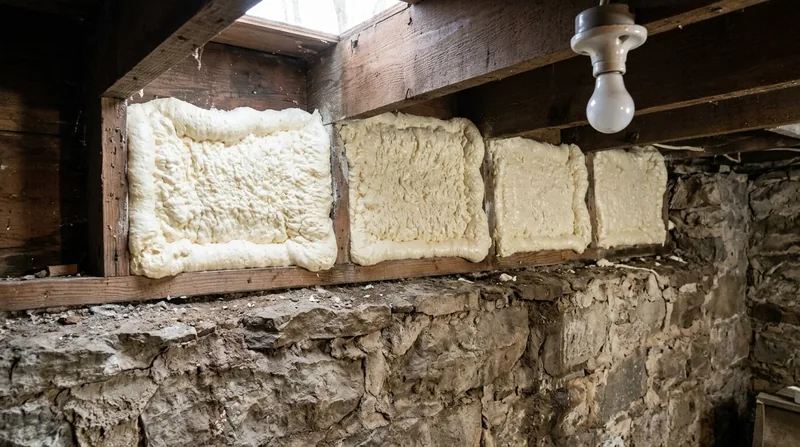




Rim joist and band joist spray foam insulation in Dayton seals the cold air gap where your foundation meets the house frame, stopping drafts and condensation that plague older basements across the Miami Valley. Homes in the Oregon District, Oakwood, and mid-century ranches in Kettering and Huber Heights lose significant heat through uninsulated rim joists every winter. Cold basement air rises into rooms above, and moisture condenses on the band joist during humid summers and damp spring thaws. Spray foam closes that thermal boundary, cutting drafts and protecting the rim joist from seasonal moisture swings. This is entry-level spray foam work with immediate payback in comfort and lower heating bills.
Why Rim Joist and Band Joist Insulation Matters in Dayton's Older Housing Stock
The rim joist is the wooden frame that sits on top of your foundation wall and carries the house floor. In Dayton's Oregon District, South Park, and older Oakwood homes, this gap is often left open to the basement, creating a direct path for cold air to enter the house. Mid-century ranches in Kettering, Huber Heights, and Trotwood were built with vented attics and thin insulation, leaving rim joists completely exposed. In winter, cold air from the basement rises through the rim joist into the first floor, making rooms feel drafty and forcing your furnace to work harder. In summer and spring, humid air condenses on the cold band joist, wetting the wood and creating conditions for rot and mold growth.
- Spray foam seals the rim joist air-tight, blocking cold basement air from entering the conditioned space.
- The foam provides R-value (typically R-6 per inch for closed cell) that holds the rim joist above the dew point, preventing condensation.
- A sealed rim joist reduces the load on your furnace and air conditioner, lowering seasonal energy costs.
- The foam protects the wood rim joist from moisture and seasonal rot, extending its life.
Sealing the rim joist is one of the fastest ways to improve basement comfort and reduce the draft complaints that drive heating bills up in Dayton winters.
Key info: Dayton's basement rim joists sit on stone or block foundations that stay cold year-round. The seasonal moisture swing from damp spring basements to dry winter air means the rim joist is a year-round condensation risk. Spray foam solves both the air leak and the moisture problem in one pass.
How We Seal Your Rim Joist: The Process
Rim joist sealing is straightforward: we inspect the band joist area from the basement, measure the gap, and spray closed cell foam to fill and seal it. The foam expands to fill the cavity, bonds to the rim joist and foundation wall, and hardens in place. The job typically takes one day for a single-story basement or a few hours for a basement with a small footprint. Mechanical ventilation runs during the cure period to manage VOC off-gassing. After 24 to 48 hours, the foam is fully cured and the space is safe to re-enter.
- We access the rim joist from the basement and identify the full length of the gap between the foundation and the rim.
- We seal any large holes or gaps with foam backer rod to prevent overspray into the rim cavity.
- We spray closed cell foam in two or three passes, building to the target thickness (typically 2 to 3 inches for R-12 to R-18).
- We verify the foam is fully expanded and adhered to both the rim joist and the foundation wall.
- We run a fan or open windows during cure to ventilate the basement and manage odor.
The job is complete when the foam is fully cured and the basement is back to normal air quality, typically within 48 hours of the spray date.
Example: A Centerville ranch with a full basement and a 120-linear-foot rim joist typically takes 4 to 6 hours of spray time. A Beavercreek split-level with a finished basement and partial rim joist exposure might take 2 to 3 hours. We give you a time estimate during the free inspection so you know what to expect.
Rim Joist Sealing Methods: Which Approach Works Best
| Approach | Description | Best For |
|---|---|---|
| Closed Cell Spray Foam | High-density foam (R-6 per inch) that hardens rigid and creates an air and moisture barrier. Typical thickness 2 to 3 inches for R-12 to R-18. | Standard rim joist sealing in Dayton basements where moisture control and R-value are both priorities. |
| Open Cell Spray Foam | Lower-density foam (R-3.5 per inch) that is softer and more permeable. Requires thicker application (4 to 5 inches) for equivalent R-value. | Budget-conscious sealing where vapor permeability is acceptable and the rim is not exposed to standing water. |
| Injection Foam (Closed Cell) | Spray foam injected into a cavity between rim and rim cover board, confined and controlled. Cleaner application with less overspray. | Finished basements or tight spaces where direct spray is not practical or where a finished appearance is required. |
| Combination: Foam + Air Sealing | Spray foam on the rim joist combined with caulk or sealant on rim band seams, band joist rim seams, and rim-to-sill connections. | Maximum air-sealing performance. Recommended for older Dayton homes where multiple small leaks compound the draft problem. |
Closed cell foam is the standard choice for Dayton rim joists because it provides both R-value and moisture protection in a compact thickness. Open cell is a lower-cost alternative if budget is tight and the basement stays relatively dry. Injection foam is cleaner for finished basements. Combination sealing adds caulk to seams and connections, maximizing the air-seal benefit.
Rim Joist and Band Joist Spray Foam Cost in Dayton: What to Expect
Rim joist sealing is one of the most affordable spray foam jobs because the area is small and the access is straightforward. Starting price is around $650 for a modest basement with 60 to 80 linear feet of exposed rim joist. Larger basements with 120+ linear feet of rim joist, or basements with finished spaces that require extra care, run $1,200 to $2,000. The cost depends on the length of the rim joist, the height of the gap, whether the basement is finished, and whether you combine the rim joist work with crawl space or attic sealing.
Getting two or three estimates from local contractors is smart because pricing and approach vary. Some contractors spray thicker foam for higher R-value, others focus on air-sealing efficiency. Some include follow-up caulking on seams, others do not. Our estimates include the R-value, thickness, linear feet, and the type of foam proposed, so you can compare apples to apples. For a detailed breakdown of pricing and options, visit our full pricing page.
Rim Joist and Band Joist Spray Foam Near Me: What to Look for When Hiring a Contractor
Hiring a spray foam contractor is a straightforward process if you know what to verify. Start by asking any contractor whether they carry full insurance coverage, which we do. Request references from recent jobs in your neighborhood, Dayton or nearby cities like Kettering, Huber Heights, or Centerville. Ask for a written estimate that includes the R-value, thickness in inches, linear feet of rim joist, and the type of foam (closed cell or open cell). A contractor who gives you a price without those specs is cutting corners. Verify that mechanical ventilation will run during cure and that you will have a clear re-entry window, typically 24 to 48 hours. Do not accept a promise to spray immediately after the job is done or a claim that the smell will be gone in hours; that is a sign of inadequate curing protocol.
If your home is in a historic district or an HOA community, check with your local building department or HOA to confirm whether rim joist sealing requires approval. Most rim joist work is not visible from the street and does not trigger architectural review, but it is worth a quick call. If your basement has moisture problems, standing water, or signs of mold, address those first or work with a contractor who will walk away from a wet substrate rather than spray over it.
For a free estimate and to discuss your rim joist sealing project, contact us at (937) 800-4951. We respond within 24 hours and provide a written estimate with no obligation to book.
Rim Joist & Band Joist Spray Foam in Dayton: Pricing Guide
| Service | Price | Details |
|---|---|---|
| Small basement (60-80 linear feet of rim) | Starting at $650 | Closed cell foam 2 inches thick, includes inspection, material, labor, and 24-hour ventilation setup |
| Medium basement (100-120 linear feet of rim) | Starting at $1,100 | Closed cell foam 2 to 3 inches thick, includes full-perimeter sealing and follow-up caulk on band seams |
| Large or finished basement (120+ linear feet or finished spaces) | Starting at $1,600 | Closed cell foam with injection method or combination foam plus air-sealing, requires site inspection for accurate scope |
| Open cell option (budget alternative) | Starting at $450 | Open cell foam 4 to 5 inches thick for equivalent R-value, lower cost but less moisture control than closed cell |
| Travel and estimate | Included / Free | No mileage fee in Dayton and surrounding areas. Free written estimate within 24 hours, no obligation to book |
Indicative pricing, the exact cost depends on square footage, finish, and site access. Free personalized estimate within 24h at (937) 800-4951.


