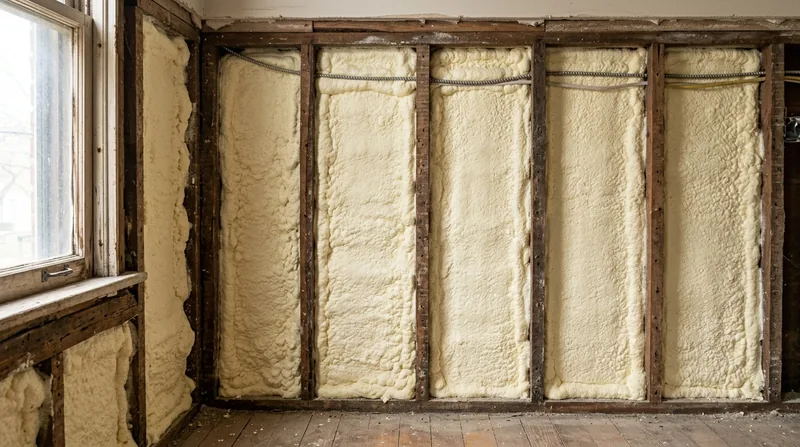




Open cell spray foam insulation in Dayton fills the odd stud bays and rafter cavities found in the Oregon District's older homes, mid-century ranches across Kettering and Huber Heights, and newer two-story builds in Centerville and Beavercreek. Unlike closed cell foam, open cell expands to seal irregular spaces at a lower cost per board foot, making it the right choice for whole-house attic and wall retrofit work across the Miami Valley. The region's cold, snowy winters drive heating demand first, and humid summers push moisture inward through walls and attics, so air sealing and insulation work hand in hand here. Dayton's basement and crawl space moisture problems are year-round, but the peak season for attic work runs from late spring through early fall when roof access is safest and spray cure times are predictable. We help Dayton homeowners understand when open cell is the right answer, how to prepare the job, and what to expect from start to finish.
Why Open Cell Spray Foam Matters in Dayton's Older and Mid-Century Homes
Dayton's housing stock spans three distinct eras, each with its own air-sealing challenge. Homes in the Oregon District and near South Park have open wall cavities and stone basements that stay damp after rain, while mid-century ranches in Kettering and Huber Heights sit with thin, settled fiberglass in vented attics and uninsulated rim joists above the foundation. Newer subdivisions toward Centerville and Beavercreek bring two-story construction with rooms over garages, where hot attics and cold rim joists drive both heating and cooling costs. Open cell foam adapts to all three: it fills irregular stud bays without demolition, seals rafter cavities that fiberglass misses, and costs less than closed cell when the job is large.
- Open cell expands to fill odd stud bays and rafter cavities found in older Dayton homes without requiring wall demolition.
- The lower cost per board foot makes it the practical choice for whole-attic and whole-wall retrofit jobs across the Miami Valley.
- It provides sound dampening in interior partitions and between floors, a benefit closed cell does not offer at the same price.
- Open cell cures to a soft, permeable foam that allows moisture to move through the material, reducing vapor-trap risk in humid climates.
- It bonds to irregular substrates and odd angles better than blown-in fiberglass, which settles and leaves gaps over time.
These qualities make open cell the right answer for sealing the attics, walls, and interior cavities that make Dayton homes leak energy and money.
Key info: A mid-century ranch in Huber Heights with a vented attic and thin fiberglass typically loses 25 to 40 percent of its heating and cooling energy through the attic and rim joist. Open cell foam seals both in one job, without the cost of closed cell or the settling risk of blown-in fiberglass.
For more information on how spray foam insulation works across your home, see our guide to attic spray foam insulation in Dayton.
How We Install Open Cell Spray Foam Insulation in Dayton Homes
The open cell spray foam process begins with a site walkthrough to measure the space, check for moisture or contamination, and confirm that the substrate is sound and dry. We inspect attic ventilation rules that apply at your address, verify any HOA restrictions on exterior work, and explain what the local building department requires for thermal barriers and ignition barriers. Once the scope is clear, we prepare the space, seal gaps and cracks around penetrations, and spray the foam in controlled passes at the manufacturer ratio and drum temperature. Mechanical ventilation runs during cure, and we provide a re-entry window of 24 to 48 hours before the space is occupied.
- We perform a free site estimate to measure the space, check for moisture, and confirm what permits and codes apply at your address.
- We prepare the substrate by sealing large gaps and cracks that would waste foam and reduce R-value uniformity.
- We spray the foam in controlled passes at the correct thickness per pass, maintaining the manufacturer ratio and drum temperature throughout.
- We run mechanical ventilation during cure to manage off-gassing and ensure even polymerization of the foam.
- We provide written documentation of R-value and thickness, and we explain the re-entry window and post-cure care for your space.
This systematic approach ensures the foam cures correctly, bonds fully to the substrate, and delivers the R-value promised on your estimate.
Example: A 1,200-square-foot attic in Dayton with open rafter bays and no existing insulation takes 4 to 6 hours to spray and seal. We apply 5.5 inches of open cell foam (R-19 to R-21 depending on density), seal all rim joist and band joist penetrations, and run ventilation for 24 hours before the homeowner can return to normal use. The same attic in Centerville with cathedral ceilings and a sealed roof deck requires additional care to prevent vapor problems, and we discuss that trade-off before we begin.
For detailed guidance on the air sealing that works alongside spray foam, see air sealing in Dayton.
| Approach | Description | Best for |
|---|---|---|
| Open Cell Attic Fill | 5 to 6 inches of open cell foam sprayed across the attic floor and rafter cavities to R-19 or R-21, sealing all penetrations and rim joist edges. | Vented attics in older and mid-century homes with thin or settled fiberglass; cost-effective whole-attic retrofit. |
| Open Cell Wall Cavity Fill | Open cell foam injected or sprayed into existing wall cavities from the interior without demolition, filling stud bays and sealing air leaks. | Oregon District and older Dayton homes with open stud cavities; retrofit insulation without exterior work or structural disruption. |
| Open Cell Sealed Rafter Cavity | Open cell foam sprayed between rafters and roof deck in cathedral ceilings or sealed attics, with attention to vapor drive and roof ventilation. | Newer homes in Centerville and Beavercreek with cathedral or vaulted ceilings; requires vapor analysis before spray. |
| Open Cell Interior Partition | Open cell foam sprayed into interior wall cavities for sound dampening and air sealing between conditioned spaces. | Two-story homes and split-level ranches where noise transfer between floors or rooms is a concern; bonus thermal and acoustic benefit. |
Open Cell Spray Foam Insulation Cost in Dayton: What to Expect
Open cell spray foam in Dayton starts at approximately $0.55 per board foot, which translates to $1,100 to $1,800 for a typical 1,200-square-foot attic retrofit at 5 to 6 inches depth. The final cost depends on the actual square footage of the space, the depth required to meet your R-value goal, substrate condition, and whether existing insulation must be removed first. A mid-century ranch in Kettering with a vented attic and settled fiberglass may need removal before spray, which adds cost but ensures the foam bonds properly and delivers the promised R-value. A newer home in Centerville with a sealed roof deck and cathedral ceilings requires vapor analysis and may call for closed cell foam instead, which costs more but prevents moisture problems in humid summer months.
Factors that move the cost up or down include the following:
- Substrate preparation: wet, contaminated, or leaking areas must be fixed before spray, or the job does not proceed.
- Existing insulation removal: blown-in fiberglass, mineral wool, or failed foam must be extracted and disposed of before new foam is applied.
- Access and complexity: attics with many penetrations, tight rafter bays, or obstacles require more time and care.
- Thermal barrier requirement: local code may require a thermal barrier (drywall or intumescent coating) over the foam, adding cost and time.
- Travel time: jobs in Dayton and surrounding areas include travel at no extra charge, but jobs beyond our service area may carry a mileage fee.
The best way to know the true cost for your home is to request a free estimate. We measure the space, identify what needs to happen first, and provide a written quote with R-value and thickness specifications. There is no obligation to book, and we respond within 24 hours at (937) 800-4951.
For a full breakdown of pricing across all our services, see our pricing page.
What to Look for When Hiring an Open Cell Spray Foam Contractor Near Me in Dayton
Dayton's spray foam market includes local independent shops, national franchises, and out-of-state crews that move from job to job. The difference between a reliable contractor and a problematic one shows up in how they estimate, how they prepare the job, and whether they are reachable if something goes wrong after the work is done. A reputable contractor provides a written estimate with R-value and thickness specifications, explains what permits and codes apply at your address, and describes the cure timeline and re-entry window. They also carry full insurance, can provide proof of coverage, and have a local address and phone number you can reach.
- Ask for a written estimate that includes the R-value, thickness, board footage, and the cost breakdown by area or phase of work.
- Verify that the contractor carries full insurance and ask to see a certificate of coverage naming your address as an additional insured.
- Check references from recent jobs in Dayton, Kettering, or Huber Heights, and call to ask about the quality of the work and the contractor's responsiveness after the job.
- Confirm what permits are required at your address by contacting your local building department, and verify that the contractor knows the rules for thermal barriers, ignition barriers, and attic ventilation that apply to you.
- Ask about HOA restrictions if you live in a master-planned community in Beavercreek or Centerville, and confirm that the contractor is familiar with those rules.
- Avoid contractors who promise immediate re-entry, offer a price far below market without an on-site visit, or cannot provide verifiable insurance information.
A contractor who walks away from a wet substrate, explains the moisture problem first, and discusses whether blown-in insulation or closed cell foam might be the better choice for your situation is showing you the expertise that protects your home and your money.
When you are ready to move forward, contact us for a free estimate. We will walk through the job, answer your questions, and explain what applies at your address before you decide.
Open Cell Spray Foam Insulation in Dayton: Pricing Guide
| Service | Price | Details |
|---|---|---|
| Open Cell Attic Insulation | Starting at $0.55/board ft | 5 to 6 inches across attic floor and rafter cavities; cost varies by square footage and whether existing insulation must be removed first |
| Open Cell Wall Cavity Fill | Starting at $0.55/board ft | Interior retrofit without demolition; cost depends on linear feet of wall, stud spacing, and accessibility from inside the home |
| Open Cell Sealed Rafter or Cathedral Ceiling | Starting at $0.65/board ft | Higher density and vapor analysis required; cost increases due to roof deck complexity and moisture control measures needed in humid climates |
| Insulation Removal and Replacement | On estimate | Removal of blown-in fiberglass, mineral wool, or failed foam adds cost; scope and disposal method determined during site visit |
| Travel and Service Area | Included | No separate mileage fee or call-out charge for jobs in Dayton, Kettering, Huber Heights, Centerville, Beavercreek, and surrounding areas |
| Free Estimate | Free | Response within 24 hours at (937) 800-4951; written quote includes R-value, thickness, and cost breakdown; no obligation to book |
Indicative pricing, the exact cost depends on square footage, finish, and site access. Free personalized estimate within 24h at (937) 800-4951.


