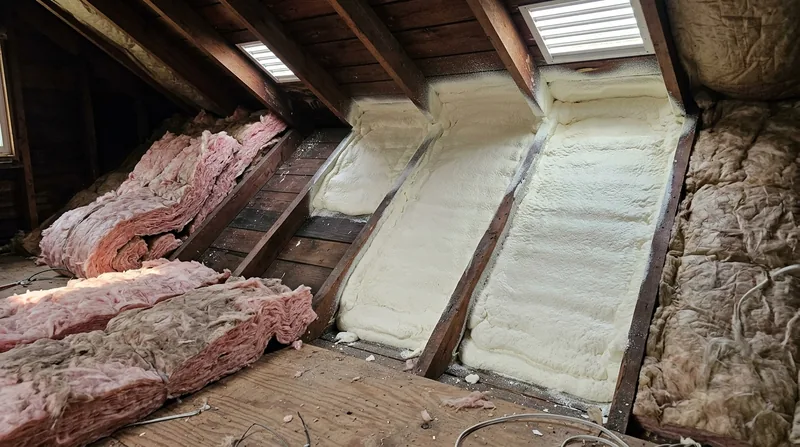




Dayton's older housing stock, from the Oregon District bungalows to mid-century Kettering ranches, was built with insulation that has settled, compressed, or deteriorated over decades. Cold winters in the Miami Valley and hot, humid summers put constant pressure on thin attic layers and uninsulated rim joists. Insulation replacement and re-insulation in Dayton restores the thermal envelope that time and weather have worn away, bringing attics and crawl spaces back to code performance. Whether you're dealing with settled fiberglass in a 1960s split-level or degraded foam in an older retrofit, we remove the failed material and install spray foam sized for the climate and your home's actual needs. The result is lower energy bills, fewer cold spots, and a more stable indoor environment year-round across Greater Dayton.
Why Insulation Replacement Matters in Dayton's Mixed Housing Stock
Dayton spans three distinct residential eras, each with its own insulation failure mode. Oregon District and Oakwood homes have open wall cavities and damp basements that were never properly insulated. Kettering and Huber Heights ranches and split-levels sit with vented attics holding thin, settled fiberglass and uninsulated rim joists above stone or block foundations. Newer two-story builds in Beavercreek and Centerville have rooms over garages and cathedral ceilings where the original foam has sagged or lost contact with the deck. In all three cases, the insulation no longer performs, and energy costs climb steadily.
- Settled fiberglass loses R-value and no longer fills the cavity, leaving air gaps that let heat escape in winter and enter in summer.
- Degraded spray foam from older retrofits can shrink, separate from the substrate, or fail to maintain its original thickness and thermal resistance.
- Damp insulation in crawl spaces and rim joists loses effectiveness and creates conditions for mold growth and wood rot.
- Uninsulated rim joists above basement or crawl space foundations account for 15 to 20 percent of heat loss in older homes and are often overlooked during initial builds.
Replacing failed insulation with spray foam addresses the root cause: poor air sealing, inadequate R-value, and moisture intrusion. A professional assessment tells you what's worth saving and what must come out.
Key info: A Kettering ranch with 1970s fiberglass in the attic and uninsulated rim joists typically sees a 20 to 30 percent reduction in heating costs after a full replacement with closed-cell foam. Results vary by home age, insulation type removed, and climate zone.
For specific guidance on what applies to your address, consult the City of Dayton Building Department or your local municipal office, which oversees permits and energy code compliance for your zip code.
How We Replace Insulation in Dayton: Step-by-Step Process
Insulation replacement begins with a full inspection and removal of the failed material. We assess the substrate (attic deck, rim joist, basement wall, or crawl space beam), identify any moisture or contamination, and confirm that the structure is sound and dry. Once the old insulation is out, we air-seal penetrations, rim edges, and band joists, then install spray foam to the thickness and R-value your home needs. The entire process is documented with photographs and a written estimate that specifies R-value and thickness.
- We inspect the attic, crawl space, or wall cavity and photograph existing conditions before removal begins.
- We remove all failed insulation, bag it, and haul it away; contaminated or wet material is handled with extra care and disposed of properly.
- We clean the substrate and identify any air leaks, moisture sources, or structural issues that must be corrected before foam is applied.
- We air-seal rim joists, band joists, rim edges, and penetrations with closed-cell spray foam or caulk, depending on the location and substrate.
- We spray the main insulation layer (open cell or closed cell) to the specified thickness, maintaining proper drum temperature and resin ratio throughout.
- We provide mechanical ventilation during cure and post a re-entry window of 24 to 48 hours before the attic or space is occupied.
The result is a complete, sealed thermal layer with no gaps, no settling, and documented R-value performance. Learn more about insulation removal and how we prepare the substrate for a successful retrofit.
Real example: A Centerville home with a cathedral ceiling over a garage had open-cell spray foam that had sagged and lost contact with the roof deck. We removed it, sealed the rim and band joists, and installed new closed-cell foam to R-30 thickness. The homeowner reported warmer rooms over the garage and quieter attic noise within the first heating season.
Insulation Replacement & Re-Insulation Methods: Which Is Right for Your Home?
Choosing the right insulation type depends on the space, the climate, and your priorities. Closed-cell spray foam delivers high R-value in a thin layer and provides moisture and vapor control, making it the standard for rim joists, crawl spaces, and sealed attics. Open-cell spray foam is lower cost and offers sound dampening, making it suitable for vented attics where moisture is not a concern. Blown-in fiberglass is sometimes the right answer for a simple top-up of sound attic insulation, though we typically recommend spray foam for its durability and air-sealing performance.
| Approach | Description | Best for |
|---|---|---|
| Closed-Cell Spray Foam Replacement | Dense foam with high R-value per inch (R-6 to R-7), acts as a vapor barrier and provides structural reinforcement. | Rim and band joists, sealed attics, crawl spaces, and moisture-prone areas in basements. |
| Open-Cell Spray Foam Replacement | Lighter foam with R-value of R-3.5 to R-3.8 per inch, allows vapor transmission and dampens sound. | Vented attics, interior walls, and sound-dampening applications where moisture control is not critical. |
| Blown-In Fiberglass Top-Up | Low-cost loose-fill insulation added over existing attic insulation to boost R-value without full removal. | Sound attics with settled but not contaminated insulation where a modest R-value boost is the goal. |
| Complete Attic Replacement with Closed-Cell Foam | Full removal and replacement with closed-cell foam, seals all air leaks and creates a conditioned attic if needed. | Older attics with failed insulation, uninsulated rim joists, and HVAC equipment that benefits from a sealed, conditioned space. |
Each method has a different cost and performance profile. Closed-cell spray foam costs more upfront but delivers the highest R-value and the best moisture control. Open-cell spray foam is a middle ground between cost and performance. A free on-site estimate will help you understand which approach fits your home and budget.
Insulation Replacement and Re-Insulation Cost in Dayton: What to Expect
Insulation replacement pricing in Dayton starts at around $2,800 to $3,500 for a typical attic or crawl space, depending on the size of the space, the depth of foam required, and the type of insulation removed. A small rim joist retrofit in a Kettering ranch might run $1,200 to $2,000. A full attic replacement with closed-cell foam in a larger Centerville home can reach $6,000 to $10,000 or more. The primary cost drivers are square footage of the space, R-value target (which determines foam thickness), the complexity of air sealing, and whether the substrate is wet or contaminated and requires additional prep.
We always provide a written estimate with R-value and thickness specifications before any work begins. This estimate is free and comes with no obligation to hire us. If you're comparing quotes from multiple contractors, ask each one for the same level of detail: the R-value, the foam thickness in inches, the square footage, and the type of foam (closed-cell or open-cell). A vague estimate with no specifications is a red flag.
Travel is included in our pricing across Dayton and surrounding areas, with no separate mileage fee. If your home is in Trotwood, Vandalia, or Fairborn, the cost to reach you is already factored into the estimate. For a detailed breakdown of pricing by service type and area, visit our full pricing overview.
Insulation Replacement & Re-Insulation Near Me: What Dayton Homeowners Should Know Before Hiring
Choosing the right insulation contractor matters as much as choosing the right insulation type. The spray foam trade includes both local independent shops and national franchises, and there are also rig-and-run crews that spray a job in an afternoon and are gone before the smell fades or a problem emerges. Here's how to verify any contractor you're considering, including us.
- Ask for proof of current insurance coverage and verify it with the insurer directly, not just by looking at a certificate.
- Get written estimates from at least two contractors and compare them side by side, including R-value, thickness, square footage, and the type of foam.
- Check references from recent jobs in Dayton, Kettering, or your neighborhood, and ask about the contractor's responsiveness after the job was done.
- Confirm that the contractor will obtain any required permits and will coordinate with your local building department (requirements vary by city and zip code).
- If you live in a master-planned community or HOA, check whether exterior work or attic venting changes require architectural approval before you sign a contract.
- Ask what the re-entry window is and whether the contractor will provide mechanical ventilation during cure, not just open windows and hope.
A professional contractor will answer all these questions clearly and provide references without hesitation. If a contractor promises rock-bottom pricing with no inspection, guarantees immediate re-entry, or cannot provide proof of insurance, walk away. For a free, no-obligation estimate and a chance to ask questions directly, contact us or call (937) 800-4951. We've been in business since 2016 and stand behind every job with a written workmanship warranty.
Insulation Replacement & Re-Insulation in Dayton: Pricing Guide
| Service | Price | Details |
|---|---|---|
| Small rim joist retrofit (crawl space or basement) | Starting at $1,200 | Includes removal of old insulation, air sealing, and closed-cell foam application to rim and band joists in a typical 1,000 to 1,500 sq ft home |
| Attic insulation replacement (open-cell foam) | Starting at $2,800 | Includes removal of failed fiberglass or foam, substrate prep, and new open-cell spray foam to R-24 or R-30 in attics up to 1,500 sq ft |
| Attic insulation replacement (closed-cell foam) | Starting at $4,200 | Includes full removal, air sealing, and closed-cell spray foam to R-30 to R-40 in sealed or conditioned attics with rim joist sealing included |
| Crawl space insulation replacement | Starting at $3,500 | Includes removal of old material, substrate cleaning, closed-cell foam application to walls or rim beams, and vapor control in crawl spaces 800 to 1,200 sq ft |
| Large or complex replacement job | On estimate | Multi-zone retrofits, contaminated substrates, or homes with multiple insulation failures require an on-site inspection to determine scope and pricing |
| Free estimate and consultation | Free | Response within 24 hours at (937) 800-4951, includes written R-value and thickness specifications, no obligation to book |
Indicative pricing, the exact cost depends on square footage, finish, and site access. Free personalized estimate within 24h at (937) 800-4951.


