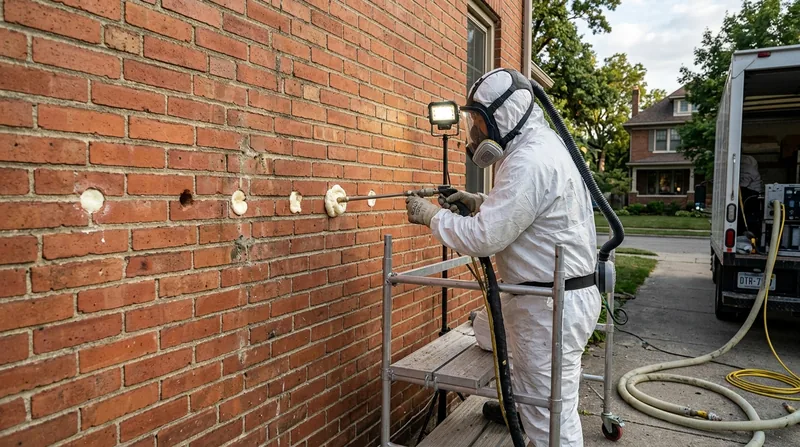




Homes in Oakwood, South Park, and other established Dayton neighborhoods often have hollow wall cavities that bleed heat all winter long. Wall and injection foam insulation fills those empty spaces without tearing open walls, sealing drafts in homes built before modern construction standards. The Miami Valley's cold winters and humid summers create a two-way vapor battle: moisture pushes inward during summer humidity and reverses in dry winter air, making air-tight wall sealing critical. Older masonry and frame homes in these districts lose significant heat through uninsulated cavities between studs, rim joists, and band boards. We drill small access holes, inject closed or open cell foam into those voids, and seal the holes afterward, restoring thermal control and stopping the draft that makes rooms feel cold even when the furnace runs. This targeted retrofit costs far less than opening walls and delivers results you feel within days.
Why Wall and Injection Foam Insulation Matters in Dayton's Older Neighborhoods
The Oregon District, Oakwood, South Park, and similar pre-1960 residential areas in Dayton were built with no insulation or minimal fiberglass in exterior walls. Stone and block foundations were common, and vapor barriers did not exist. These homes lose heat through wall cavities, band joists above the foundation, and rim joists in basements. The result is cold perimeter rooms, uneven temperatures throughout the house, and heating bills that climb every winter. Injection foam retrofits address this without renovation, making them the practical choice for homeowners who want performance without gutting the walls.
- Empty wall cavities in pre-1960 homes allow heat to escape directly to the outside air.
- Cold rim and band joists above basements and crawl spaces drive moisture problems and drafts year-round.
- Injection foam seals these voids in a single day, restoring comfort in rooms over unheated garages or basements.
- No drywall removal, no weeks of reconstruction, no disruption to occupied spaces.
- The foam adheres to studs, block, and masonry, creating a continuous air barrier that stops convective heat loss.
Homeowners in Kettering, Huber Heights, and Centerville report that injection foam in exterior walls and rim joists reduces drafts and evening temperature swings within the first heating cycle.
Key info: Ohio's building code requires that spray foam used in walls be covered by a thermal barrier (drywall, plaster, or other approved material) to meet the fifteen-minute flame-spread requirement. We apply foam only to cavities that are already enclosed, or we install an approved barrier afterward. Your local building department in Dayton, Kettering, or Beavercreek will specify which applies to your address. See the Ohio Building Code Authority for code details and permitting requirements in your city.
How We Inject Foam Into Walls: The Process in Dayton Homes
Injection foam retrofit starts with a site visit to identify wall cavities, assess moisture conditions, and plan access points. We drill small holes (typically 1 to 1.5 inches) into exterior walls, either from the basement looking up into rim joists or from inside the home into wall cavities. We then inject closed or open cell foam at a controlled rate, monitoring pressure and fill to ensure complete cavity coverage without overfilling. Once cured (typically 24 to 48 hours), we patch the access holes with wood plugs or caulk, and the wall is finished. The entire process is non-invasive and leaves no structural damage.
- We drill access holes into rim joists, band joists, or exterior walls at strategic points to reach empty cavities.
- We inject foam at a controlled rate, using pressure monitoring to fill voids completely without damaging studs or masonry.
- Closed cell foam provides higher R-value and vapor resistance for below-grade rim joists and damp basements.
- Open cell foam offers lower cost and easier retrofit in dry above-grade wall cavities where vapor permeability is acceptable.
- We patch all access holes and leave the wall ready for paint or finish as needed.
A typical injection project in a South Park or Oakwood home takes one to two days, depending on the number of cavities and wall length. See our air sealing page for details on sealing other envelope leaks once injection foam is in place.
Example: A 1950s Oakwood colonial with a stone foundation and uninsulated rim joist was losing heat at the band board, making the first-floor rooms along the exterior cold. We drilled access holes into the basement rim joist from inside the basement, injected closed cell foam into the cavity, and sealed the holes. The homeowner reported a 10 to 15 degree temperature rise in the adjacent rooms within the first week of heating season. Total time on site was one day.
Injection Foam Methods: Closed Cell vs. Open Cell
| Method | Description | Best For |
|---|---|---|
| Closed Cell Injection | High-density foam (typically 2.0 to 2.2 lb/cu ft) with R-value around 6.0 to 6.5 per inch. Resists moisture and vapor transmission. Cures rigid and hard. | Rim joists above basements, band boards in damp conditions, walls in high-humidity zones, cavities requiring vapor barrier performance. |
| Open Cell Injection | Lower-density foam (typically 0.5 to 0.7 lb/cu ft) with R-value around 3.5 to 3.7 per inch. Allows vapor transmission. Cures soft and flexible. | Interior wall cavities in dry conditions, retrofit of older homes where vapor permeability is preferred, cost-sensitive projects where R-value per inch is secondary. |
| Cavity Prep and Moisture Check | We inspect cavities for water damage, active leaks, or standing moisture before injecting foam. If moisture is present, we address it first or recommend alternative solutions. | All injection projects. Wet or contaminated cavities receive no foam; we walk away and refer structural or water remediation. |
| Patching and Finishing | Access holes are sealed with wood plugs, foam backer rod, and paintable caulk. Interior holes are finished flush; exterior holes receive weather-resistant closure. | All injection jobs. Patching is included in the estimate and completes the project. |
Wall and Injection Foam Insulation Cost in Dayton: What to Expect
Injection foam insulation in Dayton typically starts at $2 per square foot of wall area treated, though the actual cost depends on several factors. Access difficulty, cavity depth, foam type (closed cell versus open cell), and the number of drill points all affect the final price. Rim joist injection in a basement is often simpler and lower-cost than reaching cavities in upper-story exterior walls. Closed cell foam costs more per board foot than open cell but delivers higher R-value and vapor resistance, making it the standard choice for below-grade and damp locations. A typical single-family home retrofit of rim joists and problem wall cavities ranges from $2,000 to $6,000, depending on scope.
The best way to understand cost for your home is to request a free, no-obligation estimate. We visit your property, identify cavities, measure wall and joist areas, and provide a detailed quote with R-value, thickness, and material type specified. Visit our pricing page for additional cost context and factors that influence the final number.
Two to three estimates from different contractors will help you compare not just price but also scope, material choice, and workmanship warranty. Be wary of estimates with no R-value or thickness listed, no mention of cavity inspection, or prices far below market. The cheapest bid is often the one that cuts corners on material ratio, curing conditions, or access inspection.
Wall and Injection Foam Insulation Near Me: What to Look for When Hiring a Contractor in Dayton
Hiring the right spray foam contractor is as important as choosing the material itself. Look for a contractor with a local address, local phone number, and the ability to respond to questions after the job is done. Verify that the contractor carries full insurance coverage, ask to see the certificate, and confirm that it includes liability and property damage. Request at least two references from recent injection or retrofit jobs in Dayton or nearby communities, and call those references to ask about the quality of the work, the crew's professionalism, and whether the homeowner would hire them again.
- Confirm the contractor carries full insurance and can provide proof of current coverage.
- Request a written estimate that specifies foam type, R-value per inch, thickness, and the number of board feet to be installed.
- Ask whether the contractor uses mechanical ventilation during cure and what the re-entry window is (typically 24 to 48 hours).
- Verify that the contractor inspects cavities for moisture and refuses to spray over wet or contaminated substrates.
- Check whether the contractor addresses thermal barriers and code compliance for your specific address and city.
- Confirm the workmanship warranty period and what it covers (typically one to three years on the installation).
Contact us at (937) 800-4951 for a free estimate. We serve Dayton, Kettering, Beavercreek, Centerville, and surrounding areas in the Miami Valley. Our estimates are detailed, our crew is local, and we stand behind every job with a workmanship warranty and full insurance coverage.
Wall & Injection Foam Insulation in Dayton: Pricing Guide
| Service | Price | Details |
|---|---|---|
| Rim and Band Joist Injection | Starting at $2/sq ft | Closed cell foam for below-grade cavities, including access drilling, cavity inspection, foam application, and patching of all holes |
| Exterior Wall Cavity Injection | Starting at $2/sq ft | Open or closed cell foam depending on moisture conditions, access points, and cavity depth; includes full cavity fill and finishing of access holes |
| Multi-Cavity or Large Retrofit | On estimate | Projects spanning multiple walls, floors, or complex joist systems require on-site measurement and moisture assessment before pricing |
| Travel and Site Visit | Included | No mileage fee or travel surcharge within Dayton and surrounding service areas; estimate visit is free and no-obligation |
| Free Estimate | No charge | Detailed written estimate with R-value, thickness, and material type specified; response within 24 hours at (937) 800-4951 |
Indicative pricing, the exact cost depends on square footage, finish, and site access. Free personalized estimate within 24h at (937) 800-4951.


