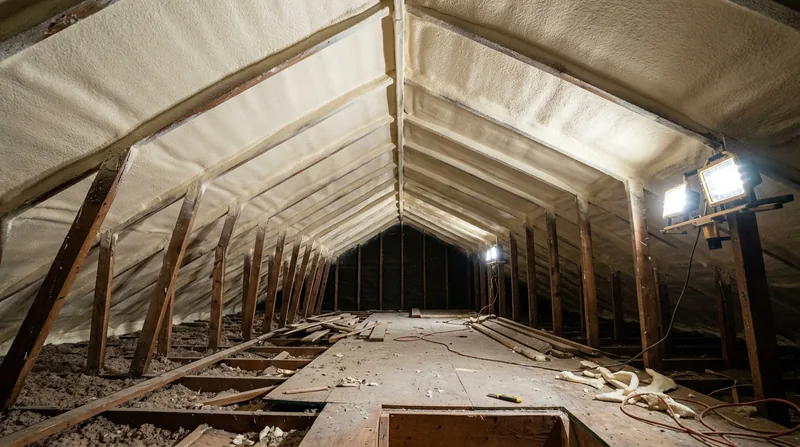




Attic spray foam insulation in Dayton stops the seasonal moisture and temperature swings that plague older and mid-century homes across the Miami Valley. Dayton attics swing from freezing winter air to hot, humid summer heat that drives moisture upward through vented cavities, settling on rim joists and creeping into walls. The Oregon District and Oakwood hold stone basements that stay damp after rain; Kettering and Huber Heights carry mid-century ranches with thin, settled fiberglass and uninsulated rim joists; newer Centerville and Beavercreek builds have rooms over garages that stay cold in winter and hot in summer. We spray foam directly to the roof deck, sealing old vented attics against ice, heat, and humidity in one pass. The result is a conditioned attic that stops the temperature swing, cuts the moisture load, and brings steady comfort to the rooms below.
Why Attic Spray Foam Insulation Matters in Dayton's Climate
Dayton's Miami Valley climate flips moisture direction twice a year. Cold, dry winter air pulls moisture out of walls and attics; hot, humid summer air pushes it back in. A vented attic amplifies both. In winter, the attic stays near outdoor temperature, and any warm air from the house below carries moisture upward, where it condenses on cold roof sheathing and rim joists. In summer, the attic becomes a furnace, and humid outdoor air seeps through soffit vents, settling on cold ducts and band joists. Spray foam to the roof deck breaks that cycle by sealing the attic from outdoor air and creating a thermal and moisture barrier that stays consistent year-round.
- Stops ice dams and winter condensation that rot roof sheathing and rim joists in Kettering and Huber Heights ranches.
- Eliminates the hot attic furnace effect in summer, reducing strain on air conditioning and the humidity that climbs into upper-floor rooms.
- Seals air leaks around ductwork, electrical penetrations, and attic hatches that loose fiberglass never touches.
- Protects the attic substrate from the moisture swings that cause mold and wood decay in older Dayton homes with stone basements.
A sealed attic is the single largest energy and comfort payoff in Dayton homes, especially in the mid-century stock where vented attics and thin insulation are the norm.
Key info: The Dayton building department governs attic ventilation and thermal barrier requirements at your address. Sealed attics may require soffit and ridge vent closure, mechanical ventilation during cure, and a fifteen-minute thermal barrier depending on your zip code. We help you navigate what applies; the building official has the final say. Call (937) 800-4951 to confirm your local rules.
For more detail on how moisture behaves in attics and why sealed attics outperform vented ones, see our guide to closed cell spray foam insulation, which is the standard choice for roof deck sealing.
How We Install Attic Spray Foam Insulation in Dayton
Attic spray foam installation is a four-step process that starts with a walk-through and ends with a written estimate showing R-value and thickness. We assess access, existing insulation, roof condition, and any moisture or contamination. If the attic is wet, moldy, or has vermiculite (which may contain asbestos), we stop and refer you to the appropriate specialist. If the substrate is sound and dry, we proceed with removal of old fiberglass if needed, mechanical ventilation during spray, and a controlled re-entry window of twenty-four to forty-eight hours.
- We inspect the attic for moisture, mold, and existing insulation type, then provide a written estimate with R-value and thickness specifications.
- We remove old fiberglass, blown-in cellulose, or failed foam if the space requires it, and haul the debris off site.
- We set up mechanical ventilation during spray to manage fumes and ensure proper cure and off-gassing.
- We spray foam to the roof deck at the thickness needed to reach your target R-value, measured in board feet on site.
- We apply a thermal barrier (drywall or intumescent paint) if code requires it at your address.
- We mark the re-entry window and provide written care instructions for the first forty-eight hours.
The entire job, from setup to final inspection, typically takes one to three days depending on attic size and access.
Local example: A 1,200-square-foot attic in a Kettering ranch with vented soffit and ridge and thin, settled fiberglass takes one full day to strip, spray to R-38 with closed cell foam, and install a thermal barrier. A 2,000-square-foot attic in a Beavercreek two-story with cathedral ceilings and multiple roof valleys takes two days. Access, existing insulation type, and the R-value target drive the timeline.
For details on the two foam types and when each is the right choice, see open cell spray foam insulation and our closed cell spray foam pages.
Attic Spray Foam Insulation Methods and Materials
| Approach | Description | Best for |
|---|---|---|
| Closed Cell Spray Foam | High-density foam (1.5 to 2 lb/cu ft) with R-6 to R-7 per inch. Stops air and vapor completely. Requires fifteen-minute thermal barrier in most Dayton jurisdictions. | Roof deck sealing in Kettering, Huber Heights, and Beavercreek homes where moisture and air leakage are the primary concern. Attics with rim joists and band joists that need vapor control. |
| Open Cell Spray Foam | Low-density foam (0.5 lb/cu ft) with R-3.5 per inch. Allows vapor to pass through. Softer, sound-dampening, lower cost per board foot than closed cell. | Budget-conscious attic top-ups in homes where the existing roof deck is sound and the attic is not the primary moisture source. Rooms over garages where sound dampening is valued. |
| Removal and Replacement | Complete tear-out of old fiberglass, cellulose, or failed foam, haul-off, and new spray foam installation. Substrate is cleaned and inspected before spraying. | Mid-century Dayton ranches where fiberglass has settled to R-10 or lower, or older homes with contaminated or water-damaged insulation. |
| Hybrid (Foam Plus Blown-In) | Spray foam to the roof deck for air sealing and vapor control, then blown-in fiberglass or cellulose over top for cost efficiency and thermal mass. | Larger attics where the budget requires a balance between air sealing performance and material cost. Not common but effective in Centerville and Beavercreek builds. |
Each approach is priced differently and carries different performance characteristics. A free on-site estimate will clarify which method meets your needs, code requirements, and budget.
Attic Spray Foam Insulation Cost in Dayton: What to Expect
Attic spray foam insulation in Dayton typically starts at $1.50 per square foot for open cell foam applied to an accessible attic with existing fiberglass already in place. Closed cell foam, which is the standard for roof deck sealing, runs higher because it delivers superior moisture and air control. The actual price depends on four concrete factors: attic size, accessibility (walk-in versus crawl-through), whether old insulation must be removed, and the R-value target for your climate and building code.
A typical 1,200-square-foot attic in a Kettering or Huber Heights ranch that requires removal of old fiberglass and spray to R-38 with closed cell foam will fall in the range of $2,000 to $3,500, depending on the complexity of the roof structure and the number of penetrations. A 2,000-square-foot attic in a newer Centerville or Beavercreek home with cathedral ceilings and multiple valleys may run $3,500 to $5,500. These are ballpark figures; the only way to lock in a price is an on-site estimate with measurements and specifications.
Why does cost vary so much? Attic size is the obvious factor, but access matters just as much. An attic you can walk through, with a clear path to the roof deck and no obstructions, is faster and cheaper than one with low headroom, joists in the way, or ductwork that must be worked around. Old insulation removal adds labor and disposal cost. The R-value target drives thickness: R-38 takes less material than R-49, and open cell is cheaper per board foot than closed cell. Roof complexity, the number of skylights and penetrations, and the condition of the existing substrate all push the estimate up or down.
The best way to understand your cost is to request a free estimate. We measure the attic, assess the substrate, and provide a written quote with R-value and thickness clearly stated. There is no obligation to book, and the estimate is good for thirty days. Call (937) 800-4951 or fill out the contact form, and we will respond within twenty-four hours.
For a detailed breakdown of pricing across all spray foam services, see our full pricing overview.
What to Look for When Hiring a Spray Foam Contractor Near Me in Dayton
The spray foam trade has three types of operators: local independent shops, national franchises, and rig-and-run crews from out of state. The local independent is positioned against both because we are reachable, we know the local building code, and we stand behind the work. A national franchise may carry a brand name and national warranty, but permitting, liability, and local compliance fall on you. A rig-and-run crew sprays a job in an afternoon and vanishes; when the smell does not go away or the foam cracks, nobody is there to answer. Here is what to verify before you hire anyone for attic spray foam insulation in Dayton.
- Verify the contractor is fully insured and can provide a certificate of insurance for general liability and workers compensation.
- Request references from at least two attic jobs in Dayton or surrounding areas, and call them to ask about the smell, cure time, and whether the contractor was responsive after the job.
- Ask for a written estimate that includes R-value, thickness in inches, and the square footage of the attic, never just a flat price with no detail.
- Confirm that the contractor will provide mechanical ventilation during spray and a written re-entry window of twenty-four to forty-eight hours, and that they will not promise immediate occupancy.
- Check with the local building department (Dayton, Kettering, Huber Heights, or your city) to confirm whether a permit is required and whether the contractor is registered to pull it at your address.
- If you have an HOA, confirm that exterior work or roof modifications are permitted; spray foam does not usually trigger architectural review, but a sealed attic may affect soffit and ridge vent closure, which sometimes does.
- Ask whether the contractor has experience with the specific failure mode in your home: ice dams and rim joist rot in older Dayton homes, or hot attics in newer Beavercreek builds.
A contractor who can answer all of these questions clearly, provides a detailed written estimate, and is easy to reach is the one to hire. If an estimate has no R-value, no thickness, and no square footage, or if the price is far below market with no inspection, walk away.
Ready to move forward? Contact us for a free estimate or call (937) 800-4951. We will walk the attic with you, answer your questions, and provide a written quote with no obligation to book.
Attic Spray Foam Insulation in Dayton: Pricing Guide
| Service | Price | Details |
|---|---|---|
| Open Cell Spray Foam Attic Top-Up | Starting at $1.50/sq ft | Existing fiberglass in place, accessible attic, no removal needed, applied over existing substrate |
| Closed Cell Spray Foam Roof Deck Sealing | Starting at $2.50/sq ft | High-density foam for moisture and air control, roof deck application, includes thermal barrier where code requires |
| Removal and Replacement (Full Attic) | On estimate | Tear-out of old fiberglass or failed foam, haul-off, substrate inspection, and new spray foam installation cost depends on attic size and debris volume |
| Travel and Setup | Included | No separate mileage fee or travel charge in Dayton and surrounding service areas within Greater Miami Valley |
| Free Estimate | Free | On-site walk-through with measurements and written quote including R-value and thickness, response within 24 hours |
Indicative pricing, the exact cost depends on square footage, finish, and site access. Free personalized estimate within 24h at (937) 800-4951.


