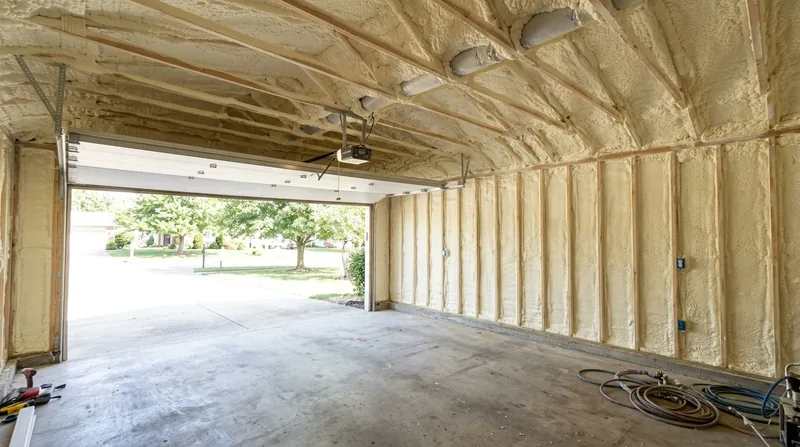




Newer two-story homes in Centerville, Beavercreek, and surrounding Dayton subdivisions often have uninsulated garages sitting directly below bedrooms and living spaces. When winter temperatures drop across the Miami Valley, that cold garage acts as a thermal bridge, pulling heat down through the ceiling and floor system into the rooms above. Garage spray foam insulation stops that transfer by sealing walls and ceilings with closed-cell or open-cell foam, restoring comfort to rooms that otherwise stay chilly no matter how hard the furnace runs. We spray foam garage walls, ceilings, and rim joists to cut the cold leak at its source, a straightforward job that pays for itself in comfort and lower heating bills within a season or two.
Why Garage Insulation Matters in Dayton's Newer Subdivisions
Dayton's residential growth toward Centerville and Beavercreek brought a wave of two-story construction where garages sit directly under occupied rooms. Unlike older homes where garages are detached or separated, these newer builds use the garage as structural support and thermal boundary. An uninsulated garage ceiling is an open door to winter cold, and the Midwest climate of the Miami Valley makes that failure obvious by November. Homeowners report that rooms over garages stay 8 to 12 degrees colder than the rest of the house, and no amount of thermostat adjustment fixes it because the heat is leaking straight through the uninsulated structure.
- Cold rooms over garages force the furnace to run longer and waste energy heating unconditioned space below.
- Uninsulated garage walls allow winter wind and outdoor temperature swings to affect the living space directly above and adjacent.
- Spray foam seals air leaks around rim joists and band joists at the garage perimeter, stopping infiltration at the source.
- Closed-cell foam adds structural rigidity and handles the moisture that can condense on uninsulated garage ceilings during humid summer months.
The fix is direct and permanent: spray foam on the garage ceiling and walls stops the cold from rising into the rooms where your family lives.
Key info: A typical two-story garage in Beavercreek or Centerville measures 400 to 600 square feet of ceiling and wall area. Spray foam at 2 inches of closed-cell covers that area and delivers R-13 to R-15 per inch, stopping the thermal leak that no amount of attic insulation can fix. The job takes one day, and rooms above warm up noticeably within 48 hours of cure.
For guidance on the permit and thermal barrier rules that apply at your address in Dayton, check with your local building department or contact us for a free estimate. We help homeowners navigate what applies to their specific location and job scope.
How We Insulate Garages in Dayton: Step-by-Step Process
Garage spray foam insulation starts with a clear assessment of the existing structure, access points, and what needs to be sealed. We inspect the garage ceiling, walls, rim joists, and any existing insulation or air leaks. Once we understand the scope, we prepare the space, protect any items that should not be exposed to spray, and set up mechanical ventilation. The foam is then applied in controlled passes, building up to the specified thickness, and we verify R-value and coverage before we leave the site. Re-entry is typically safe within 24 to 48 hours, depending on foam type and ambient conditions.
- We inspect the garage ceiling, walls, and rim joists to identify air leaks, existing insulation, and structural conditions.
- We protect the work area and set up mechanical ventilation to manage VOC off-gassing during and immediately after application.
- We apply closed-cell or open-cell foam in even passes, building thickness to meet the R-value target specified in the estimate.
- We verify coverage, thickness, and R-value on site before we consider the job complete.
- We provide a re-entry window and care instructions so the foam cures properly and your garage is ready to use within 24 to 48 hours.
The result is a sealed, insulated garage that stops cold transfer and reduces the thermal load on your heating system.
Local example: A homeowner in Kettering with a 500-square-foot garage ceiling and uninsulated rim joists called us after a cold winter left the bedroom above at 58 degrees. We sprayed 2 inches of closed-cell foam on the ceiling and sealed the rim joist band with 1.5 inches. The job took one day. Two weeks later, that room stayed at 68 degrees with the same thermostat setting. The homeowner also noticed the garage was no longer pulling cold air into the basement below.
Related work often includes rim joist and band joist sealing to complete the thermal envelope around the garage perimeter.
Garage Spray Foam Insulation Methods and Materials
| Approach | Description | Best for |
|---|---|---|
| Closed-Cell Spray Foam | High-density foam with small, tightly sealed cells. R-value of 6 to 7 per inch. Resists moisture and adds structural strength. | Garage ceilings and walls where moisture control and durability are priorities. Recommended for Dayton's humid summers and damp basements. |
| Open-Cell Spray Foam | Lower-density foam with open cells. R-value of 3.5 to 4 per inch. Flexible, sound-dampening, and cost-friendly. | Garage ceilings where sound control matters and moisture is not a primary concern. Requires adequate ventilation to manage humidity. |
| Rim Joist Sealing | Closed-cell foam applied to the band joist and rim area where the garage meets the foundation. Stops cold air infiltration and moisture entry. | Garages with uninsulated rim joists, especially in Centerville and Beavercreek builds where the garage sits over a basement or crawl space. |
| Full Garage Enclosure | Spray foam applied to ceiling, walls, and rim joists for complete thermal and air sealing. Addresses all thermal bridges in one project. | Two-story homes where rooms above the garage stay cold and comfort is the priority. Highest energy impact and longest payback horizon. |
Each approach is tailored to your garage layout, the rooms above, and your budget. Closed-cell foam delivers the highest R-value and moisture control; open-cell is the lower-cost option for sound and basic insulation. We recommend closed-cell for garages in the Miami Valley because of the seasonal humidity swings and the risk of condensation on uninsulated ceilings.
Garage Spray Foam Insulation Cost in Dayton: What to Expect
Garage spray foam insulation in Dayton typically starts at $1,200 for a small, straightforward garage ceiling. The final price depends on the size of the garage, the thickness of foam needed to meet your R-value target, access to the work area, and whether rim joists or walls are included. A full garage enclosure in a 500-square-foot space with closed-cell foam and rim joist sealing usually runs between $2,500 and $4,500. Open-cell foam costs less per square foot but requires more thickness to reach the same R-value, so the total savings may be smaller than expected. The best way to understand the cost for your specific garage is to get a written estimate that specifies the R-value, thickness, and square footage of the work.
- Garage size is the primary cost driver, measured in ceiling and wall square footage that will be sprayed.
- Foam type (closed-cell or open-cell) and target R-value determine how many inches of material you need and the per-board-foot cost.
- Access and existing conditions (old insulation removal, structural repairs, tight spaces) can add labor time and materials.
- Rim joist and band joist sealing add to the scope but are often necessary to stop the cold leak completely.
We provide written estimates with R-value and thickness specifications so you know exactly what you are paying for. See our full pricing overview for typical ranges, or contact us at (937) 800-4951 for a free estimate tailored to your garage and location.
Garage Spray Foam Insulation Near Me: What Dayton Homeowners Should Know Before Hiring
Choosing the right spray foam contractor is as important as the insulation itself. A poorly installed job can leave you with odor complaints, incomplete coverage, or foam that does not cure properly. Before you hire anyone, verify that they are fully insured, ask for references from recent garage projects in your area, and request a written estimate that includes R-value, thickness, and square footage. Ask about their process for mechanical ventilation during cure, their re-entry timeline, and what warranty they offer on the workmanship. If your garage is in an HOA community, check whether exterior work or structural changes require approval before we start. Most garage insulation does not require a permit, but it is worth confirming with your local building department, especially if rim joists or structural work is involved.
- Verify that the contractor is fully insured and ask to see a current certificate of insurance before work begins.
- Request references from at least two garage insulation jobs completed in Dayton within the last year.
- Get a written estimate that specifies R-value, foam thickness in inches, square footage, and a total price or price range.
- Ask about mechanical ventilation during cure, the re-entry window, and the workmanship warranty period.
- Check your HOA architectural guidelines if you live in a master-planned community, and confirm with your local building department whether a permit applies to your job.
The strongest indicator of a quality contractor is a clear, detailed estimate with no surprises and a straightforward answer to every question. Contact us at (937) 800-4951 for a free, no-obligation estimate and we will walk you through the entire process so you know what to expect.
Garage Spray Foam Insulation in Dayton: Pricing Guide
| Service | Price | Details |
|---|---|---|
| Garage Ceiling Only (Closed-Cell) | Starting at $1,200 | Basic garage ceiling spray foam at 2 inches, typical 400 sq ft, includes R-value and thickness verification |
| Garage Ceiling and Walls (Closed-Cell) | Starting at $2,000 | Full garage enclosure with foam on ceiling and walls, 500 to 600 sq ft, stops cold transfer into rooms above |
| Full Garage with Rim Joist Sealing | Starting at $2,800 | Ceiling, walls, and band joist foam for complete thermal envelope, includes moisture control and air sealing around foundation |
| Open-Cell Garage Insulation | Starting at $900 | Lower-cost option for garage ceilings, open-cell foam at greater thickness to match R-value, sound-dampening benefit included |
| Existing Insulation Removal Plus Spray Foam | On estimate | Jobs requiring removal of old fiberglass, mineral wool, or failed foam before new spray foam application, priced per scope and material type |
| Free Written Estimate | Free | On-site assessment with R-value and thickness specs, response within 24 hours at (937) 800-4951, no obligation to book |
Indicative pricing, the exact cost depends on square footage, finish, and site access. Free personalized estimate within 24h at (937) 800-4951.


