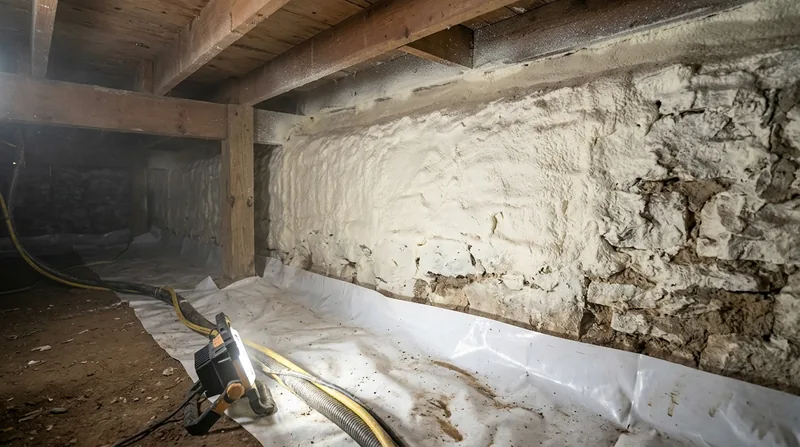




Crawl spaces under Dayton-area homes stay cold and damp, especially after heavy Miami Valley rain. The region's older and mid-century housing stock, from the Oregon District through Kettering and into Huber Heights, often sits over crawl spaces with uninsulated band joists and exposed concrete block walls that absorb moisture year-round. Cold floors above, rising damp below, and humidity that flips with the seasons create the perfect conditions for energy loss and structural decay. Crawl space spray foam insulation seals the walls and band joist area to block moisture and cut cold floors across Montgomery and Greene counties. We spray closed cell foam directly onto the band joist, rim, and crawl space walls to create an air and moisture barrier that holds up in the wet Midwest climate. The result is warmer floors, lower heating bills, and protection against the mold and rot that damp crawl spaces breed.
Why Crawl Space Foam Insulation Matters in Dayton and the Miami Valley
Dayton's climate flips moisture drive twice a year. Winter air is dry, so vapor pressure pushes inward from wet soil and concrete. Summer humidity reverses that load, driving moisture in from outside air. A vented crawl space or an uninsulated band joist cannot stop either direction. Cold concrete floors sit directly above the crawl space, and uninsulated rim joists let heat escape straight into the soil. The band joist, where the wood house frame meets the concrete foundation, is the weak point: it absorbs ground moisture, the wood swells and rots, and the insulation above it fails. Spray foam seals this junction completely and creates a vapor barrier that works in both directions.
- We seal the band joist and rim to block cold air from rising into the floor above.
- Closed cell foam stops moisture vapor from entering the crawl space during humid summer months.
- We seal the walls of the crawl space to reduce the volume of cold, damp air that the heating system must condition.
- Foam adheres directly to concrete block and wood, filling gaps and cracks that fiberglass batts cannot reach.
- The sealed crawl space becomes a conditioned buffer zone that keeps basement and first-floor rooms warmer and drier.
Sealing a crawl space is one of the highest-return insulation jobs in the Midwest because the failure mode is so clear and the cost of doing nothing is so visible: cold floors, high heating bills, and wood rot in the rim joist.
Local example: A 1970s ranch in Kettering with an uninsulated crawl space and vented rim joist loses heat through the floor in winter and absorbs moisture through the band joist year-round. Sealing the crawl space walls and band joist with closed cell foam stops both problems at the source, often cutting the heating load on the first floor by 15 to 25 percent.
For more information on how moisture and thermal performance interact in crawl spaces, consult the U.S. Department of Energy's guide to air sealing and insulation.
How We Spray Foam and Seal Your Crawl Space
The job starts with a walk-through to assess crawl space access, the condition of the band joist and walls, and any existing moisture or standing water. If the crawl space is wet or has active moisture issues, we do not spray. We fix the moisture first or we walk away. Once the space is dry and prepped, we spray closed cell foam directly onto the band joist, the rim, and the crawl space walls. The foam expands and hardens, creating an airtight, water-resistant barrier. We control thickness and spray pattern to meet code requirements for the R-value and thermal barrier protection. Mechanical ventilation runs during the cure period, and we set a re-entry window of 24 to 48 hours before the space is occupied. The result is a sealed, insulated crawl space that stays dry and conditioned.
- We inspect the crawl space, check for moisture, standing water, and damage to the band joist or walls.
- We prepare the space by clearing debris and ensuring the substrate is clean and dry.
- We spray closed cell foam onto the band joist, rim, and crawl space walls in controlled passes to build the specified thickness.
- We monitor the spray temperature, equipment ratio, and ventilation throughout the application.
- We verify the foam thickness and R-value with a written estimate and inspection notes.
- We set a 24 to 48 hour re-entry window and provide guidance on ventilation and re-occupancy.
The entire process is built around controlling the foam application so that it cures correctly and delivers the thermal and moisture performance the job requires.
Dayton example: A 1,200 sq ft crawl space under a Beavercreek home with a damp band joist and 1970s fiberglass batts. We remove the batts, seal the crawl space walls and band joist with 2 inches of closed cell foam, and install a continuous vapor barrier. The band joist is now protected, the crawl space is sealed, and the first floor stays warmer. Total time on site is 3 to 4 hours.
Learn more about how we handle rim joist and band joist spray foam insulation as a standalone service.
Crawl Space Foam Insulation Methods and Approaches
| Approach | Description | Best for |
|---|---|---|
| Closed Cell Foam on Band Joist and Walls | Spray 1.5 to 2 inches of closed cell foam directly onto the rim, band joist, and crawl space walls. Creates a continuous air and moisture barrier with R-value of 6 to 6.5 per inch. | Damp crawl spaces, homes in the Miami Valley with seasonal moisture, and any retrofit where the band joist needs moisture protection. |
| Sealed Crawl Space with Vapor Barrier and Foam | Spray foam on walls and band joist, then install a 6-mil polyethylene vapor barrier over the crawl space floor to prevent ground moisture from rising. | Older Dayton homes with wet crawl spaces and homes where the first floor is frequently cold or damp. |
| Band Joist Foam Only | Spray closed cell foam onto the band joist and rim in a 1.5 to 2 inch band around the perimeter, leaving crawl space walls and floor unfoamed. | Budget-conscious homeowners, homes where the crawl space is used for storage or mechanical equipment, and jobs where the crawl space is already reasonably dry. |
| Full Crawl Space Encapsulation with Foam | Spray foam on walls and band joist, install vapor barrier on floor, seal vents, and condition the crawl space as a semi-conditioned zone with controlled humidity. | High-performance homes, new construction, and homes where the crawl space is a critical part of the building envelope. |
Each approach balances cost, performance, and the specific moisture and thermal challenges of your crawl space. We recommend closed cell foam on the band joist and walls as the standard for Dayton homes because it handles the seasonal moisture flip and protects the wood structure.
Crawl Space Spray Foam Insulation Cost in Dayton: What to Expect
Crawl space spray foam insulation in Dayton typically starts at $2,500 for a band joist and rim seal on a small to mid-sized crawl space. The final cost depends on the size of the crawl space, the linear feet of band joist to seal, the condition of the substrate, and whether the space needs moisture remediation before foam can be applied. A full crawl space seal, including walls and band joist, runs higher because the foam coverage is greater. Access to the crawl space also matters: if the crawl space is tight, low, or cluttered, application takes longer and costs more. We provide a written estimate with R-value and thickness specifications so you know exactly what you are paying for and why.
The cost of doing nothing is higher. A damp crawl space with an uninsulated band joist adds 15 to 25 percent to your heating bill and exposes the rim joist to rot and structural damage. Replacing a rotted rim joist costs $5,000 to $15,000 or more. Spray foam seals the problem at the source and pays for itself in reduced heating costs and avoided repairs.
We recommend getting 2 to 3 estimates from local contractors so you can compare scope, R-value, and price. Avoid any estimate that does not specify the thickness of the foam, the R-value per inch, or the total R-value of the installation. Avoid any contractor who promises immediate re-entry or who offers a price far below market without an on-site inspection. Visit our full pricing overview to see the range for crawl space foam and other insulation services across Dayton.
Crawl Space Spray Foam Insulation Near Me: What Dayton Homeowners Should Know When Hiring
When you hire a spray foam contractor for your crawl space, verify that the company is fully insured and carries current general liability and workers compensation coverage. Ask to see the certificate of insurance and confirm that the policy covers spray foam application and the specific work you are requesting. Get the estimate in writing with R-value, thickness, and the total board feet of foam specified. Understand what the contractor will do if the crawl space is wet or has standing water: the honest answer is that we do not spray over moisture and we will recommend fixing the drainage or moisture source first. Check references from recent crawl space jobs in your area, especially homes in Dayton, Kettering, or Huber Heights with similar age and condition. Ask whether the contractor pulls permits if your city requires them for spray foam work. Dayton and other municipalities in Greater Dayton have different rules, so always verify with your local building department what applies at your address. If you have an HOA, check whether the architectural rules govern interior crawl space work (most do not, but it is worth confirming). Call us at (937) 800-4951 for a free, no-obligation estimate, and we will walk you through the process and answer any questions about how foam works in a crawl space.
- Request a written estimate that includes R-value, foam thickness, and total coverage in board feet.
- Verify the contractor is fully insured and ask to see the certificate of insurance.
- Ask what the contractor does if the crawl space is wet or has active moisture issues.
- Get references from recent crawl space jobs in the Dayton area.
- Confirm what permits, if any, your city requires for spray foam work in a crawl space.
- Understand the re-entry window and ventilation requirements after the foam is applied.
A local contractor who knows Dayton's climate, building stock, and moisture challenges is your best choice. Contact us today for a free estimate and honest guidance on whether crawl space foam is the right solution for your home.
Crawl Space Spray Foam Insulation in Dayton: Pricing Guide
| Service | Price | Details |
|---|---|---|
| Band Joist and Rim Seal | Starting at $2,500 | 1.5 to 2 inches of closed cell foam on the rim and band joist perimeter, includes written estimate with R-value and thickness specs |
| Full Crawl Space Walls and Band Joist | Starting at $4,500 | Closed cell foam on all crawl space walls and band joist, cost scales with square footage and linear feet of wall to seal |
| Crawl Space with Vapor Barrier | Starting at $5,500 | Foam on walls and band joist plus 6-mil polyethylene floor barrier, protects against ground moisture in damp Miami Valley homes |
| Moisture Remediation and Drainage | On estimate | If the crawl space has standing water or active moisture, we assess and recommend fixes before foam application begins |
| Travel and Estimates | Free estimate, included travel | No charge for the on-site walk-through and written proposal, travel included across Dayton and surrounding areas |
Indicative pricing, the exact cost depends on square footage, finish, and site access. Free personalized estimate within 24h at (937) 800-4951.


