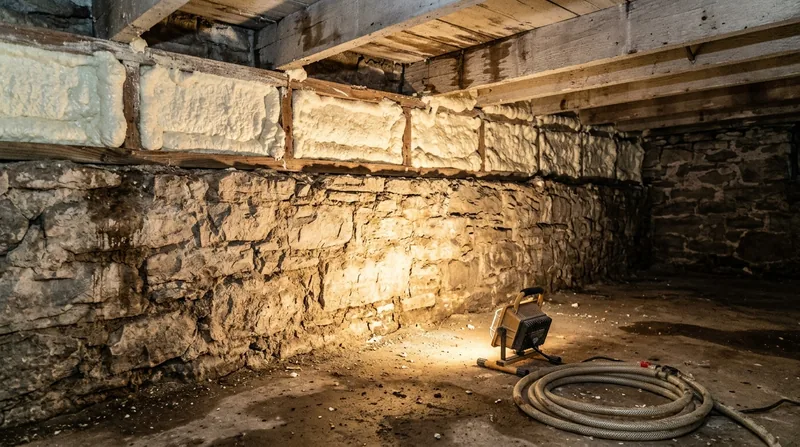




Closed cell spray foam insulation in Dayton stops moisture from wicking into rim joists, basement walls and crawl spaces across the Miami Valley's older housing stock. Dayton basements stay damp after rain, and closed cell foam blocks that moisture while delivering an air seal and structural rigidity that open cell cannot match. The Oregon District, Oakwood, and the older neighborhoods of Kettering and Huber Heights all carry stone or block foundations with chronic dampness, and closed cell is the tool that fixes it. Mid-century ranches and split-levels in those areas often have uninsulated rim joists above the foundation, where cold meets humid air and condensation pools. Newer subdivisions toward Centerville and Beavercreek bring two-story construction with rooms over garages, where closed cell seals the rim and stops thermal leaks that make those spaces unbearable in winter. We spray closed cell foam to control moisture, improve comfort, and cut energy loss where it matters most in Dayton's climate.
Why Closed Cell Spray Foam Matters in Dayton's Damp Basements and Rim Joists
Dayton sits in the Miami Valley, where basements and crawl spaces stay cold and damp year round. Spring melt and summer humidity drive moisture into rim joists and band joists above the foundation, where wood framing wicks that water and begins to rot. Open cell foam absorbs moisture like a sponge; closed cell foam rejects it. The vapor barrier and structural strength of closed cell make it the right choice for below-grade work and any rim joist in contact with soil or standing moisture. Block foundation walls, stone basements, and crawl spaces across Montgomery County's older housing stock all benefit from closed cell's moisture control.
- We seal rim and band joists above damp foundations to stop moisture from entering wood framing.
- We spray closed cell on block or stone basement walls to block water vapor and create a moisture barrier.
- We insulate crawl spaces with closed cell foam to control humidity and protect structural wood.
- We air-seal around closed cell installations to eliminate drafts and prevent thermal bypass.
- We remove old, settled insulation before spraying closed cell to ensure proper adhesion and thickness.
Each of these applications stops the moisture-driven failures that dominate Dayton's basement and crawl space repair calls.
Local example: A 1950s split-level in Kettering with an uninsulated rim joist and a damp basement wall develops condensation every spring. Closed cell foam sprayed on the rim and sealed to the foundation wall stops that moisture before it reaches the wood, and the homeowner sees no more damp spots on the rim or the band joist above the foundation.
For more detail on moisture control in below-grade spaces, see our crawl space spray foam insulation and rim joist and band joist spray foam pages. For regulatory guidance on attic ventilation and thermal barriers in Dayton, consult your local building department or the City of Dayton Building Division.
How We Install Closed Cell Spray Foam Insulation in Dayton
Closed cell foam is sprayed in thin passes, typically two to three inches per application, and allowed to cure between coats. The process requires controlled drum temperature, correct spray equipment ratio, and mechanical ventilation during cure to manage off-gassing. We inspect the substrate before spraying to confirm it is dry, clean and free of contamination. If a rim joist or basement wall is wet or actively leaking, we do not spray; we fix the moisture first or we walk away. Once the substrate is ready, we spray closed cell to the specified thickness and R-value, allow the proper cure time, and verify the installation meets code and the homeowner's performance targets.
- We schedule a site visit to assess the substrate, moisture condition, and access for spray equipment.
- We provide a written estimate that specifies R-value, foam thickness, and the number of passes required.
- We confirm the substrate is dry and prepare the area, including protective coverings and ventilation setup.
- We spray closed cell foam in controlled passes, maintaining proper equipment ratio and temperature.
- We allow adequate cure time between passes and before the space is reoccupied (typically 24 to 48 hours).
- We inspect the cured foam for coverage, thickness and adhesion, and document the installation with photos and specifications.
This methodical approach ensures the foam performs as designed and avoids the smell, off-gassing and safety issues that rush jobs create.
Example from Dayton: A 1920s Tudor home in the Oregon District has a stone basement wall that weeps moisture every spring and summer. We inspect the wall, confirm no active leak, and spray two inches of closed cell foam to R-14, which provides both insulation and a complete vapor barrier. The homeowner avoids tearing out the wall and gets a lasting moisture seal.
For details on how we handle insulation removal before spraying new foam, and for information on air sealing around the installation, visit those service pages.
Closed Cell Spray Foam Installation Methods and Applications
| Application | Description | Why Closed Cell Works Best |
|---|---|---|
| Rim and Band Joists | Two to three inches of closed cell foam sprayed directly onto the rim joist above the foundation, sealed to the band joist and the sill plate. | Blocks moisture vapor from the damp soil and foundation, provides R-value and structural support, and stops thermal bridging through the rim. |
| Basement and Crawl Space Walls | Two to three inches of closed cell foam sprayed on block or stone foundation walls and sealed to the rim joist above. | Creates a continuous vapor barrier that stops moisture wicking into the wall, improves basement comfort, and protects wood framing from rot and mold. |
| Crawl Space Encapsulation Prep | Closed cell foam on rim joists and band joists as part of a crawl space moisture control strategy. | Reduces moisture entry at the structural perimeter, lowers humidity, and protects wood joists from condensation and seasonal moisture swings. |
| Metal Building Condensation Control | Two to four inches of closed cell foam sprayed on the underside of metal roof decks or wall panels in pole barns and barndominiums. | Stops condensation from forming on cold steel surfaces, prevents water drip, protects stored equipment and animals, and adds structural rigidity to the building shell. |
Closed Cell Spray Foam Insulation Cost in Dayton: What to Expect
Closed cell spray foam in Dayton typically starts at around $1.20 to $1.50 per board foot, depending on the scope, substrate condition, and access. A rim joist installation on a 1,500-square-foot home with two inches of closed cell foam might run $2,000 to $3,500 before any insulation removal or additional air sealing. A larger basement wall or crawl space project can easily reach $4,000 to $8,000. The final cost depends on several factors: the thickness required (measured in inches and R-value), the substrate condition and whether removal of old insulation is needed, the accessibility of the area for spray equipment, and the scope of air sealing around the foam. Getting two or three estimates from contractors in Dayton and the surrounding areas is smart; compare the R-value and thickness specified in each estimate, not just the total price. For a detailed breakdown and current pricing for your specific application, visit our pricing page or call us at (937) 800-4951 for a free, no-obligation estimate.
Closed Cell Spray Foam Insulation Near Me: What to Look for When Hiring a Contractor in Dayton
Spray foam is not a commodity product, and the quality of the installation depends entirely on the contractor's equipment, training, and attention to detail. A good spray foam installer will provide a written estimate that specifies the R-value, foam thickness, and number of passes required. The estimate should also note any substrate preparation, removal of existing insulation, and air sealing work. Ask the contractor to explain how they manage off-gassing and ventilation during cure, and what re-entry window they recommend before the space is occupied. Verify that the contractor carries full insurance, and ask for references from recent jobs in Dayton, Kettering, Huber Heights, Centerville or nearby areas. If your project involves a basement wall or crawl space, confirm that the contractor understands local moisture conditions and will not spray over wet or leaking substrates.
- Request a written estimate that includes R-value, foam thickness in inches, and the number of spray passes.
- Ask about substrate preparation and whether the contractor will remove old insulation or contaminated material.
- Confirm that the contractor carries full insurance and can provide a certificate of coverage on request.
- Check references from recent jobs in your area, and ask about the contractor's experience with your specific application.
- Understand the cure time and re-entry window, and verify that mechanical ventilation is used during application.
- Avoid contractors who promise immediate occupancy, quote prices far below market, or offer no written specification of thickness or R-value.
The best insurance against a bad installation is to work with a local contractor who stands behind the work and is reachable if questions arise after the job is done. Contact us for a free estimate and to discuss your specific needs in Dayton or the surrounding Montgomery County area.
Closed Cell Spray Foam Insulation in Dayton: Pricing Guide
| Service | Price | Details |
|---|---|---|
| Rim Joist and Band Joist Insulation | Starting at $1.20/board ft | Two inches of closed cell foam on rim joist above foundation, sealed to sill and band joist, typical Dayton home |
| Basement or Crawl Space Wall Coverage | Starting at $1.35/board ft | Two to three inches of closed cell foam on block or stone wall, includes substrate inspection and moisture assessment |
| Metal Building or Pole Barn Condensation Control | Starting at $1.50/board ft | Three to four inches of closed cell foam on roof deck or walls, protects steel from condensation and water drip |
| Insulation Removal and Replacement | On estimate | Cost depends on volume and type of existing material; old fiberglass or settled foam must be removed before new application |
| Travel and Site Assessment | Included | No extra charge for travel within Dayton and surrounding Montgomery County service areas |
| Free Written Estimate | Free | Detailed estimate with R-value and thickness specifications, response within 24 hours at (937) 800-4951 |
Indicative pricing, the exact cost depends on square footage, finish, and site access. Free personalized estimate within 24h at (937) 800-4951.


