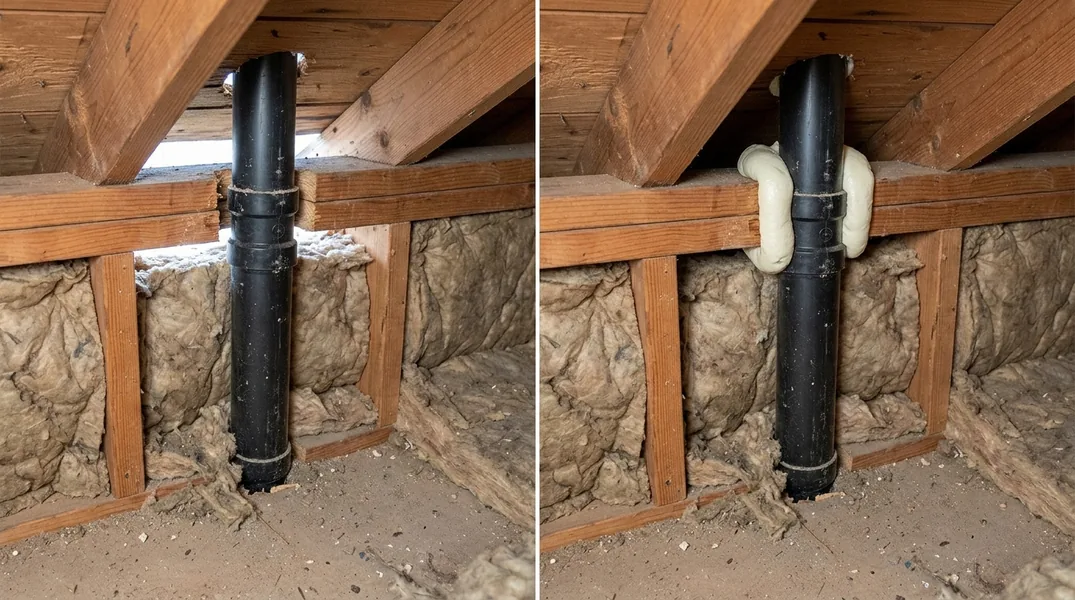
The Core Question: Air Sealing vs. Full Spray Foam
If you're a homeowner in Dayton thinking about your attic insulation, you've probably encountered two competing recommendations: air sealing alone or a complete Attic Spray Foam Insulation job. Both have merit, but they serve different goals and come with different price tags. The honest answer depends on your home's current condition, your budget, and what you're trying to achieve.
Air sealing focuses on stopping unwanted air leaks through cracks, gaps, and penetrations in your attic. This is foundational work that should happen regardless of your insulation choice. Full spray foam insulation, on the other hand, not only seals air but also provides continuous thermal resistance across every surface. Understanding the difference between these approaches will help you make an informed decision that works for your specific situation.
Understanding R-Value: What Does Spray Foam Insulation R Value Per Inch Actually Mean?
R-value measures thermal resistance, or how well a material slows heat transfer. The higher the R-value, the better the insulation performs. When we talk about spray foam insulation R value per inch, we're comparing how much thermal protection you get for every inch of thickness. This matters because it directly affects how thick your insulation needs to be and, ultimately, your project cost.
Closed Cell Spray Foam Insulation typically delivers around 6 to 7 R-value per inch, while Open Cell Spray Foam Insulation provides approximately 3.5 to 3.6 R-value per inch. This means that closed cell foam is denser and more efficient, requiring less thickness to achieve the same thermal performance. However, closed cell costs more per board foot, so your choice involves balancing efficiency against budget. For most Dayton attics, a 4 to 6 inch closed cell installation or 6 to 8 inch open cell installation will meet or exceed recommended standards.
R Value Requirements by State: What Does Ohio Require?
Ohio's building code and energy efficiency standards specify minimum R-value requirements for attic insulation. As of current guidelines, most residential attics in Ohio should have an R-value of R-38 to R-49, depending on the specific zone and the heating/cooling system in place. These requirements exist to ensure homes maintain reasonable energy efficiency and don't waste heating and cooling energy through the roof.
The reason this matters is that it sets a baseline for what you should aim for when planning your insulation project. If your current attic falls significantly below these thresholds, you're losing money on your heating and cooling bills every single month. Meeting or exceeding these requirements ensures your home performs as intended and protects your long-term investment. When you contact Dayton Spray Foam Insulation for a free estimate, our technicians will assess your current R-value and recommend a solution that meets or exceeds Ohio's standards.
How Thick Should Spray Foam Be? Finding the Right Thickness for Your Attic
Determining how thick spray foam should be depends on several factors: your desired R-value, the type of foam you choose, your budget, and your attic's physical constraints. As mentioned earlier, closed cell foam achieves higher R-values per inch, so you need less thickness. If you're aiming for R-38, you'd need roughly 5.5 to 6 inches of closed cell foam or 10 to 11 inches of open cell foam. For R-49, closed cell would require about 7 to 8 inches, while open cell would need 13 to 14 inches.
The practical reality is that most attics have structural limits. Rafters and joists have a certain depth, and you can't exceed that without creating problems. This is where professional assessment becomes invaluable. Our team at Dayton Spray Foam Insulation evaluates your attic's geometry, existing insulation, and ventilation needs to recommend the optimal thickness. In some cases, a hybrid approach combining air sealing with partial foam application delivers the best balance of performance and value. The key is ensuring your solution actually fits your space and meets your energy goals.
Insulation Tax Credit and Insulation Rebates: Money Back on Your Investment
One of the best-kept secrets among homeowners is that upgrading your insulation can qualify you for tax incentives and utility rebates. The federal government periodically offers insulation tax credits as part of broader energy efficiency initiatives, and many local utilities in Ohio provide rebate programs for homeowners who improve their home's thermal performance. These incentives can significantly reduce your out-of-pocket cost, making a spray foam project more affordable than it initially appears.
Before starting your project, research what's currently available in your area. Some programs require that work be performed by certified contractors, which is another reason to work with established local professionals. When you reach out to us at (937) 800-4951, ask about current tax credits and rebates you may qualify for. We stay current on these programs and can help you understand what documentation you'll need to claim any available incentives. Combined with our competitive pricing, these credits can make full attic spray foam insulation a smart financial decision, not just an energy-saving one.
Air Sealing or Full Foam Job? Making Your Decision
So which approach is right for you? If your attic is already well-insulated but has obvious air leaks (you can feel drafts, see daylight, or notice rodent entry points), air sealing alone might be sufficient. This is the most budget-friendly option and addresses immediate comfort and pest issues. However, if your insulation is thin, deteriorated, or non-existent, or if your energy bills are consistently high, a full spray foam installation delivers superior long-term value.
The honest truth is that most older homes in the Dayton area benefit from full foam insulation. It solves multiple problems at once: it seals air leaks, provides continuous thermal resistance, resists moisture, and lasts for decades without settling or degrading. When you factor in energy savings, improved comfort, potential tax credits, and the peace of mind that comes with a properly insulated attic, the investment typically pays for itself within a reasonable timeframe. If you're still uncertain, the best first step is getting a professional assessment. Contact Dayton Spray Foam Insulation at (937) 800-4951 or request a free estimate to discuss your specific situation with an expert who can give you honest, personalized guidance.
Looking for a professional spray foam insulation contractor in Dayton? Dayton Spray Foam Insulation responds fast for all your spray foam insulation needs.
Get a Free Quote