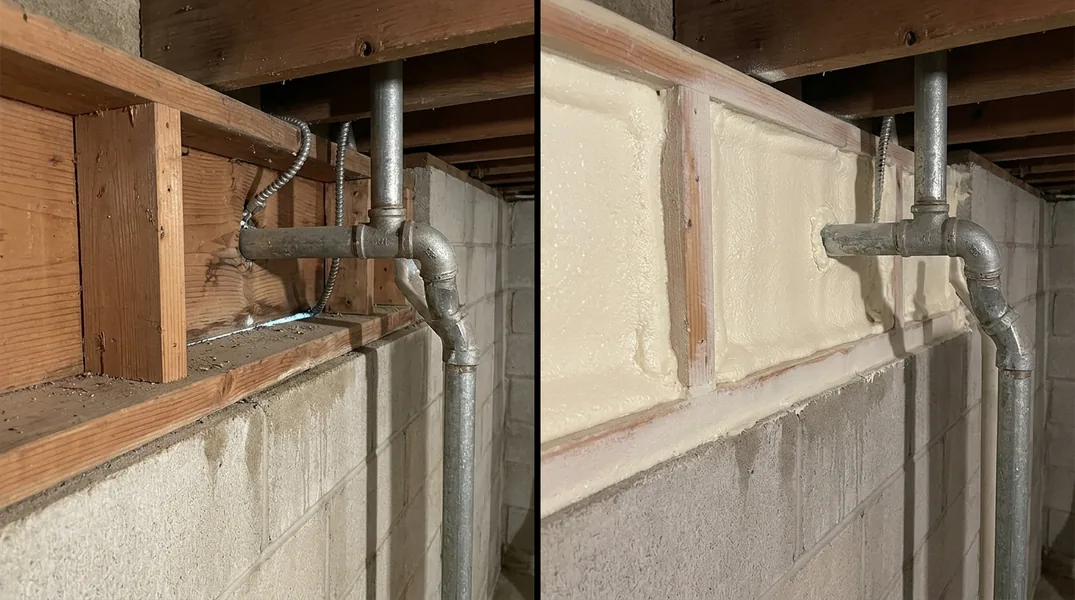
Understanding Rim Joists and Basement Cold Spots in the Miami Valley
When winter arrives in Dayton, homeowners often notice cold drafts creeping up from their basements or feeling chilled floors on the first level of their homes. These uncomfortable cold spots are rarely a mystery. They typically originate from poorly insulated rim joists, the structural members that sit atop your foundation and connect to the band board. This critical area is frequently overlooked during construction or left with inadequate insulation, creating a thermal bridge that allows frigid outdoor air to penetrate your living spaces.
The rim joist area is particularly vulnerable because it sits at the intersection of your conditioned interior space and the unconditioned exterior environment. Unlike attic insulation, which homeowners can see and assess, rim joist problems often go undetected until winter temperatures plummet and energy bills spike. In the Miami Valley, where temperatures regularly drop below freezing from December through February, this vulnerability becomes painfully obvious. Basement floors and the walls just above them become noticeably colder, and heating systems work overtime trying to maintain comfortable interior temperatures.
Why Traditional Insulation Falls Short for Rim Joists
Many homes built decades ago relied on fiberglass batts or blown-in cellulose to insulate rim joists. While these materials can work in some applications, they struggle in the rim joist environment for several reasons. Fiberglass batts are notorious for settling over time, leaving gaps that allow air infiltration. Cellulose insulation can absorb moisture, particularly in basements prone to humidity fluctuations. Both materials are also difficult to install properly in the tight, irregular spaces characteristic of rim joist construction, often resulting in incomplete coverage and thermal leaks.
Closed Cell Spray Foam Insulation represents a dramatic improvement over these conventional approaches. Unlike batts or blown-in materials, spray foam expands to fill every cavity, crack, and crevice, creating a continuous thermal and air barrier. This seamless coverage eliminates the thermal bridging that plagues traditional insulation. Additionally, closed cell foam provides superior moisture resistance, a critical advantage in basement environments where humidity can be a persistent challenge. The material also adds structural rigidity to rim joists, reinforcing your home's foundation system while simultaneously improving energy efficiency.
Spray Foam Insulation for Metal Buildings, Barndominiums, and Agricultural Structures
While residential rim joists are a primary concern for homeowners in Kettering and surrounding areas, spray foam insulation serves equally important roles in non-traditional building applications. If you own a barndominium, pole barn, or metal building structure, you face unique insulation challenges that spray foam is exceptionally well-suited to address. Metal building insulation requires a different approach than conventional residential construction because metal conducts temperature rapidly, creating condensation issues and significant heat loss.
The best insulation for metal building applications is spray foam, which adheres directly to metal surfaces and creates an unbroken thermal envelope. For barndominium owners converting agricultural structures into living spaces, spray foam provides superior performance compared to traditional fiberglass or mineral wool. Steel building insulation with spray foam prevents the condensation problems that plague metal structures and delivers the R-value necessary for comfortable year-round living. Pole barn insulation similarly benefits from spray foam's ability to conform to irregular structural members and create complete thermal coverage without gaps.
How Spray Foam Addresses Basement Floor Cold in Dayton Winters
Basement floors that feel cold underfoot during winter are often symptomatic of heat loss through the rim joist and band board area above. The problem is compounded if your basement lacks adequate wall insulation. When cold air infiltrates through an uninsulated or poorly insulated rim joist, it chills the basement space, and that cold radiates downward into the concrete floor. Homeowners frequently report that despite running their heating systems continuously, basement temperatures remain uncomfortably cool, and first-floor rooms directly above the basement feel drafty and cold.
Spray foam insulation installed in the rim joist area creates an immediate and dramatic improvement in basement comfort. By sealing the thermal bridge and preventing cold air infiltration, spray foam allows your heating system to maintain consistent temperatures throughout your home. The basement becomes warmer, first-floor rooms feel more comfortable, and your energy bills decrease noticeably. Many Dayton homeowners report that after spray foam installation, they can reduce thermostat settings by 3 to 5 degrees without sacrificing comfort, resulting in substantial heating cost savings over the winter season.
Installation Process and Why Professional Application Matters
Installing spray foam insulation in rim joists and basement areas requires specialized equipment, training, and expertise. The material is mixed on-site and must be applied at precise temperatures and humidity levels to achieve proper expansion and adhesion. Improper application can result in incomplete coverage, inadequate R-value, or structural problems. This is why attempting DIY spray foam installation is strongly discouraged. Professional contractors like Dayton Spray Foam Insulation understand the nuances of application in the Miami Valley climate, including how to account for seasonal temperature variations and moisture conditions.
When you contact our team at (937) 800-4951 for a free estimate, we conduct a thorough inspection of your rim joists, basement walls, and foundation areas to identify all thermal weak points. We then develop a customized insulation strategy tailored to your home's specific conditions and your budget. Our technicians apply spray foam with precision, ensuring complete coverage and optimal performance. The entire process is clean, efficient, and minimally disruptive to your daily life.
Energy Savings and Long-Term Value of Spray Foam Insulation
Homeowners often ask about the return on investment for spray foam insulation. While the upfront cost is higher than traditional insulation materials, the energy savings and long-term value are substantial. Homes with properly insulated rim joists and basements experience heating cost reductions of 15 to 30 percent, depending on the existing insulation condition and the extent of the upgrade. In the Miami Valley, where heating costs are significant during winter months, these savings accumulate quickly. Most homeowners recoup their investment within 5 to 7 years through reduced energy bills alone.
Beyond energy savings, spray foam insulation offers additional benefits that enhance home value and comfort. The material is durable and long-lasting, maintaining its R-value and performance for decades without settling or degradation. It improves indoor air quality by reducing dust infiltration and allergen entry. It strengthens structural components and can help prevent pest infiltration. When you combine these advantages with the immediate comfort improvements and measurable energy savings, spray foam insulation becomes one of the most cost-effective home improvements available. If you're ready to eliminate basement cold spots and reduce your winter heating costs, reach out to Dayton Spray Foam Insulation today at (937) 800-4951 or request a free estimate online.
Looking for a professional spray foam insulation contractor in Dayton? Dayton Spray Foam Insulation responds fast for all your spray foam insulation needs.
Get a Free Quote